
Love is all Around – – –

Jack makes it with time to spare for a change – – –

NI marriage

The first same sex marriage in Northern Ireland yesterday.

As we approach Valentine’s Day –

Wendy and I write a regular column for Living Tradition magazine on topics common to the American and British folk music scenes. Our most recent one was about same sex relationships in the ballads and songs as well as between the performers. It got me thinking about how these relationships were viewed as I was growing up in the Presbyterian culture of Scotland in the 1950s and 60s. I found that I couldn’t remember ever hearing anything. I suppose that it was probably hidden under the cloak of ‘female companions’ or ‘good friends’. I do know that my Grandad stopped attending Church because the minister berated two women in front of the congregation and I always wondered if that was what it was about. But I never found out the reason – if that was it then kudos to Peter Ferguson!

This got me thinking about what we consider ‘normal’, and then about the different ‘normals’ I’ve encountered over the last seventy eight years.

Living now in a fairly conservative and rural part of the United States which, until relatively recently, would have also shunned same sex couples, I see a big change. It seems like there’s an attitude of ‘sure, they’re gays but they’re OUR gays’. It’s a combination of unremarkable and un-remarked upon.

Of course it may just be because we move in particular circles, but in both Big Stone Gap and now in Wytheville we count ever more such couples among our friends.

But my ‘normal’ has changed as well over the years. Not just my personal circumstances, but the world in general. I went from a naïve apprentice house-painter to a businessman, to a college professor, to a bookstore owner. Along the way I was folksinger on the side, moved from Scotland to the US and from one marriage to another.

As I changed, learned and developed so did the world. As my ignorance was challenged so has the world’s.

There’s a ways to go yet but, but we’re getting there I hope – –
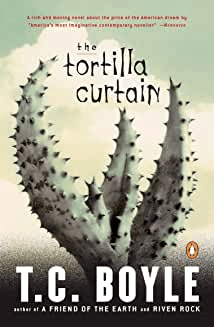
The Monday Book: The Tortilla Curtain by T.C. Boyle

The Tortilla Curtain

Apart from today, the 1990’s were perhaps the most disputatious time for immigration in America. Ronald Reagan had signed a controversial amnesty bill in 1986, and in the nineties, Bill Clinton commissioned a study of the immigration problem chaired by former Democratic Congresswoman Barbara Jordon. Immigration was at the forefront of the national conversation. Against this backdrop, T. C. Boyle wrote The Tortilla Curtain image(Penguin, 1995).

The story juxtaposes the lives of two people: Delaney, a white suburban middle-class California writer, and Candido, an illegal immigrant with his pregnant wife. The two lives cross paths when Delaney hits Candido with his car on a winding California canyon road. Candido is seriously hurt but refuses medical attention, as he is illegal and subject to deportation. Delany gives him a $20.00 bill as compensation for almost killing him.

The book is quaint in some ways, prescient in others. It takes place at a time when the term “wetback” was still used in polite conversation; before sanctuary cities, before MS13, before the Wall, before the movie Sicario, when immigrants were actually “in the shadows,” forced to hide from the law and doing  stultifying and often dangerous odd jobs for slave wages to scrape by.

Though Boyle has a knack for laying out both sides of the argument, there is no doubt where his sympathy lies. There’s no mistaking the allusion to Madonna and child, as Candido and his pregnant wife wander around the California canyons seeking shelter. Instead of a barn, she has her child in a tool shed. Candido is more Job than Joseph, as nearly all his efforts to support his wife are either fruitless or end in catastrophe.

While Candido and his pregnant wife dig for food in dumpsters, Delaney is planning his sumptuous Thanksgiving meal. Meanwhile, his neighbors complain about the Mexican invasion. They even build a wall to insulate themselves while at the same time leaving out food for the coyotes who eat their neighbor’s dogs and cats.

Through a series of coincidences Delaney and Candido cross paths several times, ending in a final cataclysm where Boyle seems to be saying that no matter our differences, we are joined by a common humanity.

The book is a sobering reminder that, as anyone who has recently watched a re-run of All in the Family knows, even after a quarter of a century we are still arguing about the same things.