I am Haunted by Cisterns …

Jack’s weekly guest blog as the haunted househusband of Big Stone Gap’s Little Bookstore…

Regular readers will have been following the refurbishment of our basement and how it tested my construction skills. When I successfully installed an “up-flushing” toilet in what we now call the “caretaker’s flat” (Wendy’s and my cozy hide-away in the bookstore basement) I thought I could rest on my laurels. After all, these places are called rest rooms in America, are they not?

Perhaps through jealousy for all the attention the upstart up-flusher was getting, two of the other three rest rooms in our bookstore promptly developed leaky toilet tanks (caused, I think, by people leaning back against them and disturbing their ancient hardened seals). In addition, the new upstairs kitchen sinks for our Second Story café started leaking! I began to have nightmares about drains, and said as much to Wendy. She looked at me with wifely sympathy and said, “I am haunted by waters.” (That’s the closing line from Norman Maclean’s story A River Runs Through It. She knows I don’t like the book, so it was a double whammy. Hmmph.)

As I tackled these haunting, daunting waters, matters were not helped by numerous trips to our local hardware, and then to Lowe’s, for obscure parts. I should explain that a toilet tank is called a ‘cistern’ in Britain. This caused much confusion-turning-to-merriment amongst the people I asked to help me.

Still and all, the patron saint of plumbers must have noticed me out of the corner of her eye,  because despite not having a clue what I was doing, I successfully fixed first the ancient leaky tanks and then the brand new sinks in the kitchen. Don’t ask me how, or expect any professional advice – I’ve no idea what I did. Perhaps swearing at inanimate fittings DOES work after all!

That was last week. And of course this week, with the polar vortex creating sub-zero temperatures, I’ve been dreading burst pipes. So you can imagine my dismay when our excellent café chef Kelley called down to me recently that there was a ‘leak in the sink’. I sighed inwardly and headed up yet again to do battle with the dreaded drain–to find Kelley working hard to keep a straight face while indicating the sink basin. In it was nestling a leek – of the garden green variety.

Ha ha, very funny. I am haunted by leeks….
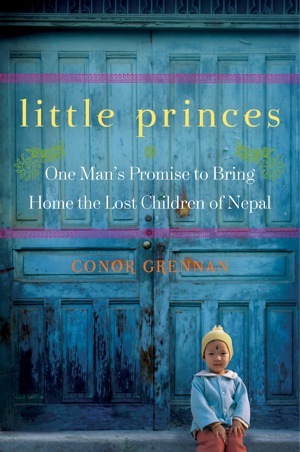
The Monday Book: LITTLE PRINCES by Conor Grennan

LittlePrinces_smallConor Grennan was just another one of those rich, thin kids who attended UVA Charlottesville. He figured three months volunteering at an orphanage in Nepal would make him interesting and a chick magnet, so he squeezed it in before spending the rest of his savings on a round-the-world trip.

Grennan went to work at Little Princes, named for the Antoine de Saint-Exupery book. Nepal at the time was in the midst of some serious and repeated coup-d-etat crap, but the rest of the world didn’t notice much, since they don’t have resources anyone else wants. Rebel armies were coming through mountain villages taking kids for soldiers or other purposes, so parents paid traffickers to escort their children to cities where they would be “safe, educated, fed, and cared for.” And of course the traffickers dumped them all over the place, with the result that “orphanages” for children with living parents back in the rural areas were springing up across the cities–for the luckier kids.

Grennan worked at a well-established children’s home, but he and his fellow staffers found a woman keeping seven children dumped on her by a trafficker, and that became the lynch pin that undid his previous happy-go-lucky life; those children were organized by the Little Princes staff to go into an established home, but the trafficker returned and whisked them away. Grennan took that personally. It’s one of those things we’ve all experienced about horrible events and statistics: numbers can be big and bad–so many dead, so many stolen–yet remote and tsk-tsk-ish until you know the names and faces of just a couple of people in that big picture. Then everything gets up close and in focus.

Grennan knew seven, so he created a non-profit, fundraised among his UVA friends, and went back to Nepal to track those young’uns down–and start a children’s charity that became orphanage-cum-reunification service. Along the way he meets a girl, converts to Christianity, and nearly dies in a mountain village.

It’s a very cool read, this book, but the thing I like most about it is Grennan’s straightforward telling of a story that could have been all about finding personal fulfillment, or the harrowing ordeals of working in Nepal. Instead this book has that boots-on-muddy-ground common sense feel, the read-between-the-lines restraint of someone who’s thought carefully about what happened, and isn’t going for the sensational thrill. He just wants you to understand the story inside The Story: those seven kids who were his responsibility, drowning in a sea of sad stories just like theirs, and how they led to Next Generation Nepal.

Reassuring, it is, to find that privileged kids in every generation aren’t just about discovering themselves striving for a personal best on a ski slope, but discovering and rectifying to the best of their ability the things going wrong around them. Go, kids, go!

You can visit Next Generation Nepal here: http://www.nextgenerationnepal.org/How_It_All_Began