
The Chicken or the Egg?

Jack getting his guest post in on time is a rare event – – –

Some regular readers will know that we have chickens free-ranging in our backyard, four to be precise. Two (Thelma and Louise) came in March and settled in easily, exploring their new surroundings and quickly began laying an egg each per day.

Then, more recently we received another two – retired government workers! They had been employed to track any evidence of West Nile Virus by having their blood tested regularly. After their stint is finished these chickens are re-homed to people who must promise not to eat them. They quickly settled in as well and within days had become good buddies with the original two. We christened one of the newbies ‘Elissa Hirple’ because she was limping when she came and the other one ‘Kathy’. But we didn’t see any eggs from them! (Also Ms. Hirple overcame her limp.)

Being novice chicken owners we did some research on their laying and found that it’s related to the amount of daylight they experience. When the days get shorter and darker they are likely to stop and about a week ago that seemed to have happened. I stopped seeing eggs in the usual corner of the coop I’d converted from an old outhouse.

When we stopped seeing the usual two per day we resigned ourselves to not getting any until Spring. When we were getting eggs regularly, Wendy preserved a couple dozen using a method involving pickling lime called ‘glassing.’

I still checked each day just in case they might provide an occasional egg, but nothing, and we began to talk about when we would break into the glassed eggs. Then yesterday as I refilled their food and water, I happened to look in a different corner of the coop and to my astonishment there were fifteen eggs. So they hadn’t stopped at all and it is almost certain that either Elissa or Kathy joined the production line!

So we now have two large containers of glassed eggs sitting on the counter, and we are still enjoying three-egg days.
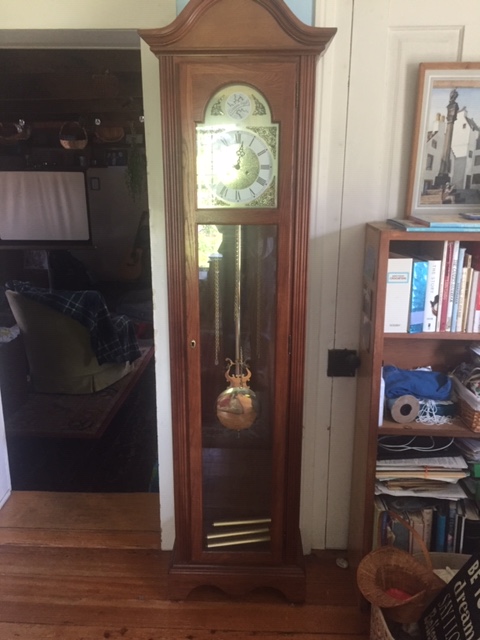
The Times they are – – –

Jack fails miserably again to get his Wednesday guest post up on time – –

Wendy and I have been ‘zooming’ with a few friends weekly ever since the pandemic closed things down. The group consists of David and Susan in North Carolina, Beth and Brandon in Big Stone Gap, Virginia, ourselves in Wytheville, Virginia, and Barbara and Oliver in Edinburgh, Scotland.

We meet on Sundays at 9 am but because of the five-hour time difference that’s 2 pm in Edinburgh. Except last Sunday was an exception because the clocks in the UK had changed on Saturday night. They don’t change here until this Saturday, so for just one week the time difference is four hours! Being half American and half Scots I was vaguely aware of the anomaly so I checked on line and – yes, this was the week of the lesser hours! A hasty last minute e-mail to Barbara saved the day – and the meeting.

But it got me curious about the whole business of changing the clocks twice a year – Spring forward and Fall back. So I did a bit of research and found some fascinating stuff. Some countries simply don’t do it at all and in many that do there’s a debate about whether to continue with it. That debate is no more heated than in the UK, and the problem is that most of the population is in south or central England where they would not see much difference in winter, whereas folk in Scotland definitely would. The European Union has a plan to stop changing the clocks in a couple of years’ time, so a strange result of ‘Brexit’ is that, if the UK sticks with clock changing, then for six months there will be an hour’s difference between Northern Ireland (in the UK) and the Irish Republic (in the EU).

By now I was well and truly hooked on the history of time-keeping and how the world arrived at any notion of ‘standard’ time. It turns out that the arrival of the railroad around the world had a lot to do with it. Prior to that local areas kept their own time, often just within the sound of church bells or a day’s travel on foot or by horse. It was the arrival of trains and reliable clocks and watches, not to mention the telegraph, that brought the need for standardized time. Since Britain owned most of the world then Greenwich Mean Time (GMT) in London became the default standard with all other time zones and/or clock changes measured relative to GMT. Although wasn’t it Mussolini who made the trains run on time?

Of course the arrival of the internet and the ability to speak to and see people on the other side of the world brings me back to what kicked off my interest in the first place – this Sunday we’ll be back to the usual five-hour difference!