
A Feast fit for Bibliophiles

The last stop on loop two of the book tour was Charlotte, North Carolina, where the Women’s National Book Association held a Bibliofeast in honor of Book Month.

I didn’t know much about the place before we got here, but Helen, a friend from college, is a member of the corporate culture and explained that Charlotte ranks only behind New York City and San Francisco as the leading financial district in America. Catching up with Helen—who in the intervening 20 years has risen in her field and raised two teenagers—was grand fun; we used to tease each other mercilessly, me the journalism major bent on “uncovering truth,” she the logistics and transport businesswoman who always won arguments by pointing out I could write all the truth I wanted, but if her trucks didn’t deliver it, it affected diddly. We agreed that the Internet had changed both our professions considerably since those earnest and robust exchanges.

(Helen also generously got us a hotel room with her “points” at Hampton Suites, where a flat screen TV embedded in the bathroom mirror faced a garden tub 3 feet around. Oh, that was fun. Thanks, Helen!)

But the bulk of the night was given to the Bibliofeast; eight writers, from mystery to memoir, gathered to spend 15 minutes per table with aspiring authors and bibliophiles from the region, talking about writing in general and our books specifically, then fielding questions.

One person asked, “When did you know you were going to be an author?” and I answered, “When my agent called me.” The women laughed, but it sparked a discussion that continued at the other tables. Most of the participants were shaping books in their minds. They wanted to know what had sparked mine, and I echoed Joan Didion, that we write to organize our thoughts, to find out what we know.

And we write because it’s fun. Musicians create music, sculptures fashion substances, cooks craft food. Everybody’s got a medium. If yours is writing, you write because it’s there. I’m not kidding, and I’m not waxing eloquent. To paraphrase a whole lot of authors over the years, the best way to tell if you’re a writer is to look down and see if you’re writing. Writers write the way runners run; it happens because you protect the time, give up other things to do it, without really thinking you’re making a decision. Even if you never publish, you write when you’re thinking the same the way you drink water when you’re thirsty or call a friend when you’re lonely. You write because you need to, want to, like to; it doesn’t feel so much like a choice as a way of life.

However, you publish because you want other people to read and like what you wrote—or because you can, or because you hope for money or recognition. (Oh, honey, let me buy you a cup of coffee and let’s chat about that last bit.) That’s different than writing; for one thing, there’s a helluva lotta marketing lurking below the surface, which most of us are not innately good at.

That was the biggest common theme at the tables of the Bibliofeast, an intimate night with lovely women–to a man, we were women, with the exception of one author who looked more and more uncomfortable as the night wore on–who had a lot of thoughts but not a lot of time to get them on paper: that the urge, the internal nudge to write is the biggest signal that one should, and its own justification.

Just write it down. Get started. Have fun. Go.

Jack and Wendy will be Malaprop’s in Asheville, NC this Sunday at 3 and in The Country Bookshop in Southern Pines, NC Monday at 6, if you or your friends and relations would like to come say hi. Jack brought his homemade shortbread.
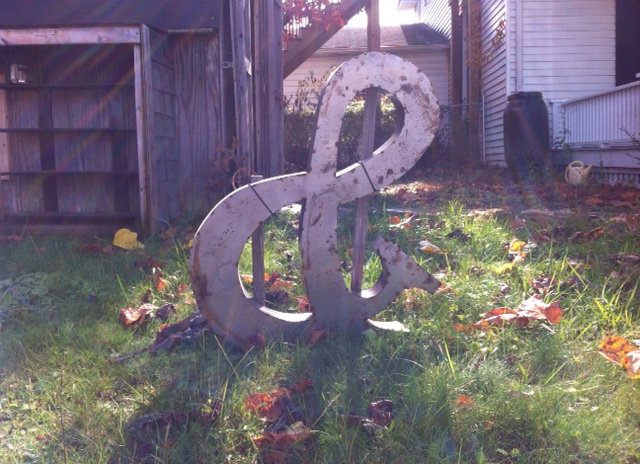
Ampersand & Lawn Ornaments

After the first leg of  Wendy and Jack’s book tour they returned with books, pictures, the leftover shortbread and one giant metal ampersand. It’s now set up in the front yard, after much deliberation over its placement. And it’s a constant reminder that ampersands are super super weird. In fact, we spent a good ten minutes debating if it was facing the right way. We’ve certainly all seen plenty of ampersands (I can’t really speak for Jack and Wendy… maybe they’ve managed to avoid them thus far). But it’s just one of those shapes that’s complex, but not quite complex enough to be memorable, so it slides right out of your mind.

Definitely facing the right way… right?

Ampersands started as a form of typographic ligature, which is a combination of two different graphemes (thanks Wikipedia!). In the case of the ampersand the two graphemes are the letters E and T, and the ligature is formed when the two are smushed together (yeah, I didn’t really see it either, but check out the ampersand in fonts like Trebuchet and you’ll get the picture). “Et” is Latin for “and,” so ampersands got their start when a bunch of Romans got too lazy to write out the full word. Which is really lazy, considering they had already worked out an “and” with one less letter than ours.

Not to sound too much like a late-night English student a bit too drunk on “literary theory”, but I’m about to act like a late-night English student a bit too drunk on literary theory. What’s cool about the ampersand is that its appearance actually matters. It’s not a letter at all, but a picture. Replace the letter “A” with “#” and nothing changes. The appearance has nothing to do with the meaning. But take two meaningless symbols and push them together into an ampersand you have something  with a meaning that only exists when it looks approximately the way it’s meant to look.

AND The Little Bookstore of Big Stone Gap

And since we love reading into pictures, the ampersand has become more than just a smushed together “E” and “T.” The best example where we’ve given it a meaning for itself, separate from “and,” comes from screenwriting, where the ampersand suggests direct collaboration, whereas “and” means one writer, followed by a second rewriter. If I pop “by Michael Crichton & Andrew Whalen” on my screenplay for Jurassic Park 5: Whatever Happened to Nedry’s Shaving Cream Can? it means that the two of us have collaborated via seance. We are equal partners. But if my Jurassic Park 5: Whatever Happened to Nedry’s Shaving Cream Can? screenplay is instead by “Michael Crichton and Andrew Whalen” it means that I took something Crichton had done and rewrote it for myself without consulting him. Take away my ampersand and I go from being the brilliant necromancer co-writer of the summer 2016 blockbuster hit to being the lonely author of rip-off fan-fiction that will never see the screen.

If I were to draw some sort of conclusion out of this, then I would say that the ampersand is an appropriate symbol to have in metal on the front lawn of your bookstore. Letters just sit on the page and we make them real as we interpret them in our heads. Writers create on the page and the readers pick up these pieces and rebuild the ideas for themselves.  Staked down on the front lawn of Tales of the Lonesome Pine, alongside a toilet overgrown with vines, a plastic dimetrodon, and several stone animals wearing wire-frame spectacles, the ampersand is a kind of visual re-creation of the first step in this process, where we take simple scratches and begin to combine them into an entire visual language that can impart meaning, feelings, or hovercraft chases through space-stations. The ampersand is not a letter or an idea: it is a simple statement of how the former becomes the latter.