
Caretaking the Eternal Library of Humanity

My friend Anita out in Kansas is looking to relocate the bookshop she manages, Al’s Old and New Books. She has discovered that some people think used bookshops are…. downmarket, while others prefer the term “passe.”

Bollocks!

Jack and I have often commented that we oversee a library of ever-changing leftovers, some of which have mass appeal, some of which have esoteric appeal. But the reason we like what we do is that we’re not full of the latest bestseller, face outward on the aisle so mega-shoppers walking to the mall can be enticed by “Oh, I heard about that on Twitter!” impulse moments.

We have the long-term, hardcore stuff. The 1970s classics on Marxism, the Leif Ungers and Robert Fords and Lisa Changes. People who write well but disappeared into the well of marketing madness with nary a splash. My agent Pamela and I were talking one day about the “nebulous” position of used book stores in the publishing world. “After all, NYC doesn’t make any money from them,” she said, but then added, “but we all benefit from them. You are the caretakers of humanity’s eternal library, aren’t you? Like a benevolent dragon trying to get the gold horde out there instead of sit on it.”

Used book stores are the place where the sounds of silence outweigh the shrieks of hawkers telling you why THIS BOOK is the Next Great Thing. You can look for yourself–and thus see for yourself–in a used books shop. In a society that equates old with “has been” rather than “wisdom,” used books shops are a place for those who know when not to swallow a line.

We love running one. And this week, we’ve sold an amazing number of  what from a mainstream point of view would be “nobody’s gonna buy these” books. We sold about 20 volumes of philosophy. No, really, PHILOSOPHY! Mostly 1960s textbooks and treatises.

We sold a great wheen of French novels, both translated and in the original language. And we sold a set of plays written in the 1700s. A cheap, simple copy for someone who wanted to look at their structure. $3.20 and out the door she went.

This is part of why used book shops matter. It’s nice to have big well-lit shops with the bestsellers in them at full retail, but it’s also nice to have a dowdy little community center where you can think for yourself. That, and the $1.50 cuppa and the comfy couches and the cat option and the fact that if you come in and say, “Oh crap, I left my wallet at home,” we will say, “Fine, we’ll write it in the ledger and you can pay us next time you come.” And the customer, who only gets down from Ohio four times a year, stares at you like you’ve gone mad, and comes back two months later and pays up.

This is why it’s important for us to be here. Downmarket, my arse. Up the caretakers of the eternal library of humanity!
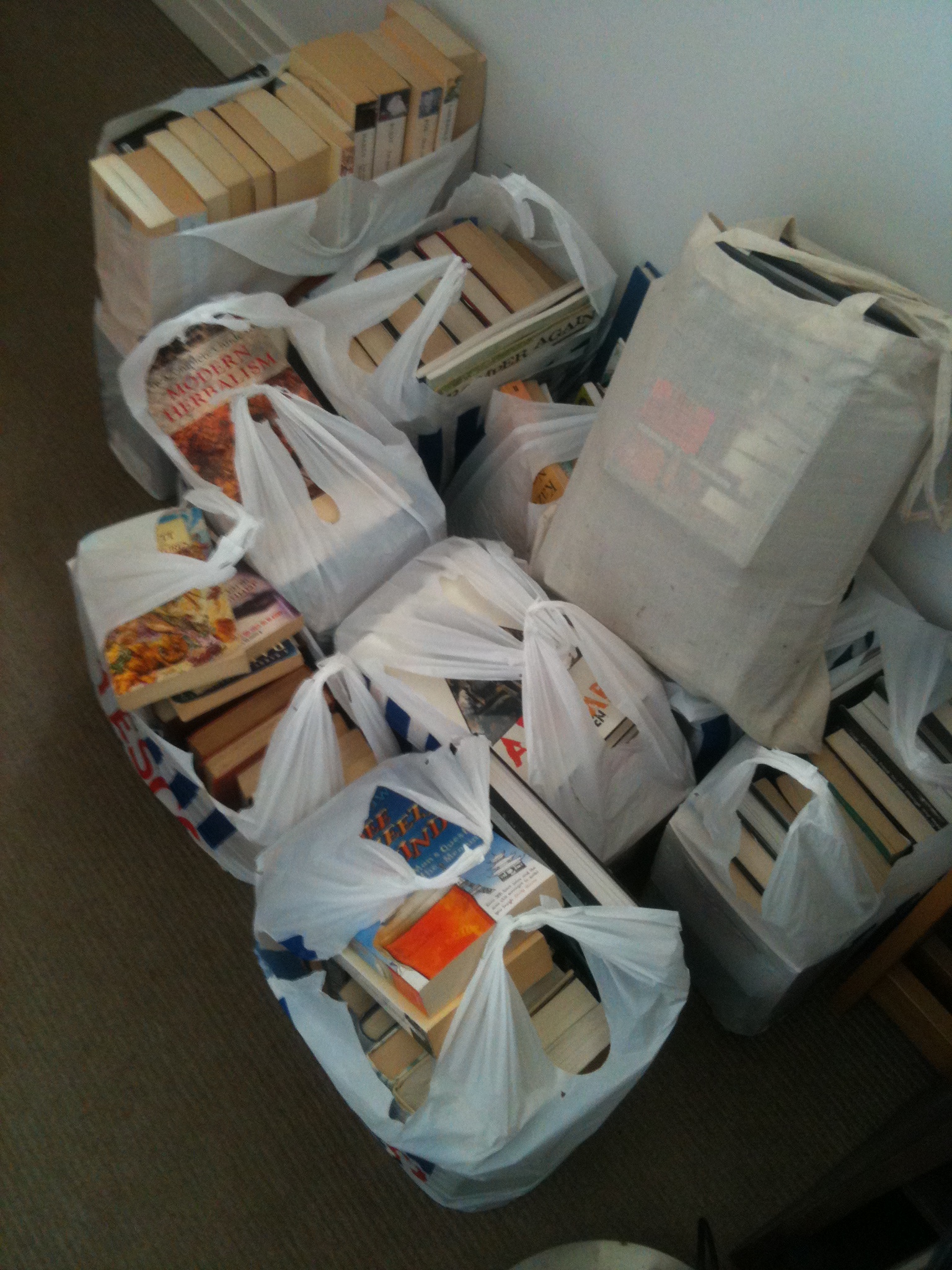
Never Judge a Book by its Black Sack Covering

books It continues to be a delight to have our lives revolve around the bookstore, to meet folks almost every day who have read Wendy’s book and made a trip to see us, and to be surrounded by ‘bookstore friends’ at the regular events we put on.

But in the middle of all that fun, we deal with the more mundane–and often tedious–jobs such as pricing and shelving the donations and books that show up—usually at the busiest times of the day or week. These unforeseen arrivals often come by the truckload, and that can be a real challenge., since we no longer have hidden spaces to store books until we can find time to sort them. In some cases, we wind up checking their current value on the Internet as well as “stick-n-stash” (as we have ignobly nicknamed pricing and shelving).

A few days ago Wendy was sitting back heaving a sigh of relief, having just dealt with a slew of these incomers; they’d arrived in dribs and drabs throughout the day, and she was proud of having cleared them in a timely manner despite having a record number of customers in the shop.

And then the door opened.

In came our good friend Cyndi Newlon (you can see her in the video tour of the bookstore, playing the corpse in our mystery room). http://www.youtube.com/watch?v=03cmGdapxPQ

Cyndi runs a writing center at the nearby college, and she’d asked if we wanted “some old library books.” Apparently, today was the day, and “some books” turned out to be ten large tightly knotted black sacks. Each one was seriously heavy, I discovered, as I helped get them out the back of her SUV and up onto the dry half of the porch.

I had been in the process of getting to grips with our brand new power washer, cleaning the soot of our front porch and outside chairs and tables after the recent big fire across the street. The arrival of Cyndi was a mixed blessing – respite from wrestling with the washer, but ….

We knew that the sacks couldn’t be left lying outside, so there was nothing for it but to dive in and start checking. Old library books are a mixed bag, often useless, but sometimes wonderful. We quickly turned up two or three hard-to-find William Faulkners, as well as quite a few rather attractive very old poetry and short story collections.

Our hearts beat faster. We warmed to the task. It’s not easy to explain to “normal” people, but bibliophiles will understand the excitement of digging through opaque sacks of old books, exclaiming over long-forgotten friends, discovering new titles.

And that’s just thinking of them as books. When you think of them as objects to be sold, well, usually with old worn ex-library books you’re lucky to find maybe one or two in every fifty that would worth hanging on to, but we were amazed with this collection. As we trawled through, we found many first editions, along with rare titles containing beautiful illustrations.

So we are grateful to Cyndi and Don for thinking of us and, once again, we learned to be grateful for what on first blush looks like a lot more work at a busy time. And we learned that you never know what good things might be hiding in a bulging black sack.