

The Between Books Blue Funk

dull bookWell, it’s happened. The miasma is upon me. After a string of really enjoyable reads, I am Between Books.

I know you’ve been there, that unhappy head space where you’ve got high, high expectations from having just finished a really enjoyable book (or, if one is lucky, a spate of three or four) and you’re tired when you go to bed because a bunch of new real-life projects are in the works, and you turn to your bedside table piled high with great choices ….

… and go flat. I like Sarah Allison’s writing–that matchmaking apple-flinger tree was one of the most lovable romance characters ever–and I admit readily the reason I can’t get into The Peach Keeper is me, not her. Or The Rebel Bookseller. It’s a great book with important things to say! So is Big Box Swindle. Each of these waits on the table by my bed, weeping softly. All of these are books I’ve looked forward to reading.

Sarah Nelson discusses in her memoir So Many Books, So Little Time how your mood and recent life moments must align in some way with what you’re reading, or you can’t get into authors even though you want to. Wise readers put them down and return later.

Usually the catalyst for breaking my Between Books Blue Funk is to read something completely different from what I normally choose. So the other night I grabbed a post-apocalyptic young adult novel, and settled in.

It didn’t work. The novel was awful, but not even awful enough to trigger the horrible-writing-response that lies dormant in all of us, inciting print-blood lust to rip the thing apart. This was more the toss-aside casual disdain of “oh, please.” In a badly-crafted amalgam of  Hunger Games goes on The Road, literary crimes are just way too obvious to ignite passion.

And so I sit, stuck. How could this happen to a bookshop owner, you ask, spoiled for choice an’ a’ that? Perhaps that’s part of the (first world) problem; too many choices reduces one to making none. Or perhaps this is the consequence of binge-watching the whole Season Four of Downton Abbey in one week. (Yes, we know, but we won’t spoil it for you.) I’ve let my reading muscles go slack.

Although I did get quite a lot of crocheting done.

Whatever the combination of reasons that have led to this winter of my book discontent, I hope it’s over soon. There are so many new writers and worlds to explore, I hate to fall behind.
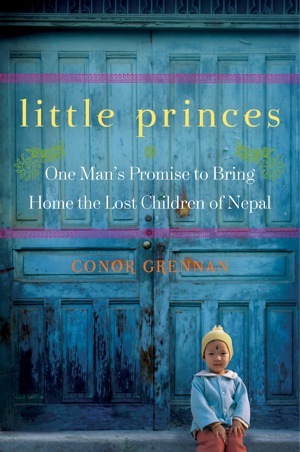
The Monday Book: LITTLE PRINCES by Conor Grennan

LittlePrinces_smallConor Grennan was just another one of those rich, thin kids who attended UVA Charlottesville. He figured three months volunteering at an orphanage in Nepal would make him interesting and a chick magnet, so he squeezed it in before spending the rest of his savings on a round-the-world trip.

Grennan went to work at Little Princes, named for the Antoine de Saint-Exupery book. Nepal at the time was in the midst of some serious and repeated coup-d-etat crap, but the rest of the world didn’t notice much, since they don’t have resources anyone else wants. Rebel armies were coming through mountain villages taking kids for soldiers or other purposes, so parents paid traffickers to escort their children to cities where they would be “safe, educated, fed, and cared for.” And of course the traffickers dumped them all over the place, with the result that “orphanages” for children with living parents back in the rural areas were springing up across the cities–for the luckier kids.

Grennan worked at a well-established children’s home, but he and his fellow staffers found a woman keeping seven children dumped on her by a trafficker, and that became the lynch pin that undid his previous happy-go-lucky life; those children were organized by the Little Princes staff to go into an established home, but the trafficker returned and whisked them away. Grennan took that personally. It’s one of those things we’ve all experienced about horrible events and statistics: numbers can be big and bad–so many dead, so many stolen–yet remote and tsk-tsk-ish until you know the names and faces of just a couple of people in that big picture. Then everything gets up close and in focus.

Grennan knew seven, so he created a non-profit, fundraised among his UVA friends, and went back to Nepal to track those young’uns down–and start a children’s charity that became orphanage-cum-reunification service. Along the way he meets a girl, converts to Christianity, and nearly dies in a mountain village.

It’s a very cool read, this book, but the thing I like most about it is Grennan’s straightforward telling of a story that could have been all about finding personal fulfillment, or the harrowing ordeals of working in Nepal. Instead this book has that boots-on-muddy-ground common sense feel, the read-between-the-lines restraint of someone who’s thought carefully about what happened, and isn’t going for the sensational thrill. He just wants you to understand the story inside The Story: those seven kids who were his responsibility, drowning in a sea of sad stories just like theirs, and how they led to Next Generation Nepal.

Reassuring, it is, to find that privileged kids in every generation aren’t just about discovering themselves striving for a personal best on a ski slope, but discovering and rectifying to the best of their ability the things going wrong around them. Go, kids, go!

You can visit Next Generation Nepal here: http://www.nextgenerationnepal.org/How_It_All_Began