The Chair Rests

We’re back on schedule! Jack blogs on Wednesdays.

Today I sing (well, type) of chairs and the strange mechanisms of Jack and Wendy’s mind.

No, don’t worry; this blog remains family-friendly….

We’ve been here six years now and until recently kept a set of wooden chairs in a bathroom cupboard, where they took up valuable storage space and were bloody awkward to get when we have events (and that’s often).

The other day, in a fit of “I must have this space” more than “Eureka!” I just distributed them around the odd corners of the bookstore as a temporary measure. Right after this, the “brass monkeys” weather (if you don’t know that saying, google it; this blog remains family-friendly) brought folk in whom we’d never seen before, passersby just looking to get warm. They bought a cup of coffee and obviously felt they should act appropriately in the store, so they sat down in the chairs and read books.

Eureka. Why didn’t we think of this sooner?

Many of our older customers have trouble bending to the lower shelves, and the chairs offer support. Plus, being a mishmash of thrift store finds, they just make the place look cozy and welcoming.

Having lived as husband and wife in four houses before we arrived here, I can now state with authority that neither Wendy nor I have any nesting instincts. It took until we were almost ready to move from each place before we finally got things organized to our liking—or even in a way that made any sense! We moved offices to every room, main bedrooms to every room, guest bedrooms to every room; Wendy once tried to move a kitchen into a bedroom.

In other words we’re just not good at forward planning – or any kind of planning. But we do serve a great cuppa, so come on down and browse. We have chairs out.
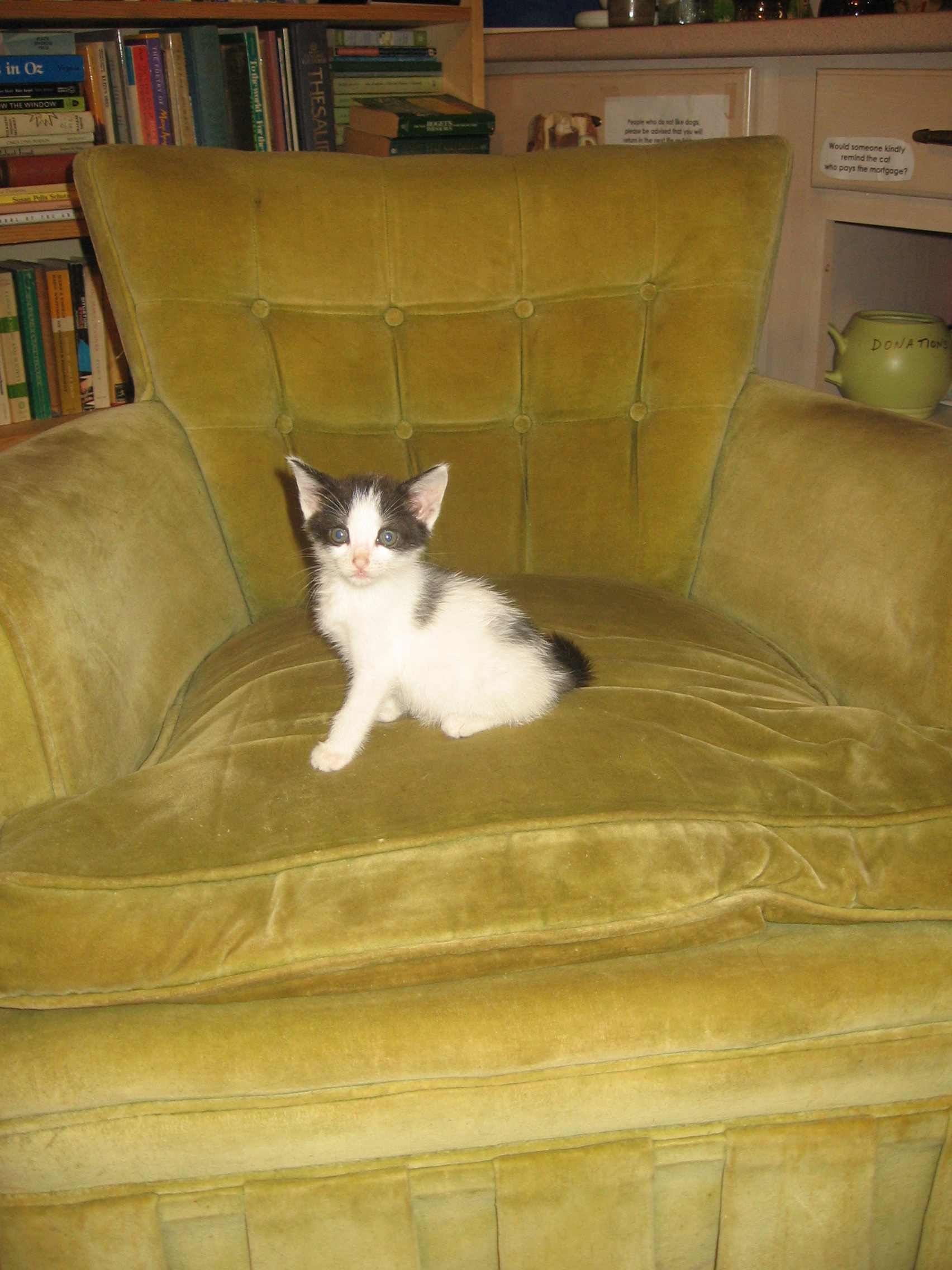
Young Owen tests a comfy chair

Young Owen tests a comfy chair

Food for Thought

Living in a bookstore is cozy and fun, but also challenging. At night, trolling for a good read, my fingers ripple across the shelves, seeking back cover blurbs that make sense, authors’ names I trust.

Because I know what I like. I know what I want to hear–and what I don’t, going off in my head, voices planted by print that will chase me down hallways, seek me out in quiet moments, and start in: “Yes, but” or even the dreaded “What if?”

These voices ask us to re-examine not so much what we believe as why we believe it, a far more intense scrutiny. What did we inherit, and what did we swallow without question, and what have we observed that supports or belies these things?

A wonderful book called Women’s Ways of Knowing says the continuum of human wisdom runs from a person who “stands in her shoes and looks out” to synthesizing pieces of knowledge to create new knowledge.

Do we only read the books that agree with us? No, probably not; most bibliophiles don’t. But do we only want from books we disagree with a sense of why their argument is wrong, invalid? Or do we listen to viewpoints we would never seek out in the greater world? Is that what bookstores are for, to let us experience–at somewhat lower risk than attending a rally or visiting a friend’s church–ideas that don’t rock our world, but could sink it?

I read certain books in certain moods. Some days I want challenge; bring on Simon Schama and Jonathan Safran Foer; yes, I will try the sushi today, thanks. Other days I want comfort; yesterday, seeking familiarity, I reread Clyde Edgerton’s Walking Across Egypt. It’s as comforting as veggie lasagna, with an equal amount of thoughtful chewing.

Books make us think, and a healthy diet includes the ones that ask us to consider another’s viewpoint. I used to teach my students, back when I was teaching, that the job of the anthropologist was to help society live with ambiguity, to put two people who believe oppositional things into a room and help them shake hands and agree not to order their subjects to kill each other. Live and let live is the motto of the ethnographer.

And the bookshop owner.