
Elwyn (by James Ryan)

As reported earlier, the short story competition was a close run thing. James Ryan’s was the first entry to arrive –

“Ahhhhhhhhhh….free at last.” How many seasons have I been lying under that bush? I hope it’s been long enough so that damned cat is dead. I don’t mean to sound like an animal hater but, it’s hard not to hate someone who buries you under a bush after peeing in your face. Don’t laugh. It was not funny at all. I’m not sure how many seasons went by before the smell left. I suppose I should be thankful that he didn’t do the other thing on me. If he had, I would probably still be stinking. Yuck!

I know you’re wondering what and who I am. My name is Elwyn and I am a Sylvan. Sylvans are associated with trees and bushes. We can be found in any woodland of any size. Our job is to keep the forest in good working order. It was my misfortune to be caught by the cat that day. Normally, I stayed high enough in the trees not to be in any danger. That day I was on the ground straightening an oak seedling that had been stepped on by a large bear the night before. It was a tiring job and when I finished, I leaned against a rock to rest from my labors. The sun was warm and the leaves were so comfortable that I fell asleep almost immediately.

The next thing I knew I was in the cat’s mouth and being carried towards the house in the distance. Talk about being scared. I was sure I was going to be eaten alive. He carried me to the bush in the yard where he played with me as if I were a ball. He batted me around and every time I tried to get away, he would let me get far enough to get my hopes up, then he would pounce on me again. He finally grew tired and went to sleep. Unfortunately for me, he went to sleep with his paw on my chest. I was just glad he had stopped throwing me around. After a while I started thinking about getting free.

The problem was that his foot was rather large and heavy. And every time I tried to move, his claws would extend and keep me where I was. I’m not quite sure how long he lay there sleeping, but it must have been several hours. I didn’t really mind because it gave me time to rest and begin to feel better about the whole thing. So far, I wasn’t dead or crippled up beyond recovery. So, I spent the time thinking of ways to escape. However, as hard as I tried, nothing came to mind.

The cat suddenly sat up, yawned, picked me up and carried me further under the bush where he dug a hole threw me in it and pissed in my face. Then he covered me up and there I stayed until the lady found me.  NOW PUT ME BACK INTO THE WOODS!
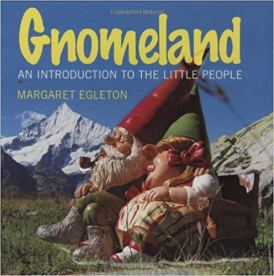
The Monday Book: GNOMELAND by Margaret Egleton

Many thanks to Jeanne Powers for this review!

gnomelandGnomeland:  An Introduction to the Little People


First off, this is not a sequel to Gnomes by Wil Huygen, the marvelous and charming “natural history” of the shy Holland gnomes.  No, this is a book about garden gnomes.


Love ‘em or hate ‘em, garden gnomes seem to pop up everywhere.  Travelocity even has a spokesgnome, possibly inspired by a rash of gnome-nappings a few years back, in which a person or persons would swipe a garden gnome and take photos of it in various settings, sometimes sending postcards back to the owner from the gnome to illustrate its travels.

Egleton devotes the first few pages of the book to a very brief overview of gnomes in general, noting that there are several variations and tracing the origin both gnomes and their appearance. Then she delves specifically into the evolution of the classic garden gnome.

The earliest statues of the “classic” garden gnome apparently were created in the late 19th century when a large ceramic industry met an enthusiasm for garden decoration. The early figures were more of the bearded and wizened little old man variety before morphing into bright and merry little figures, which Egleton attributes to Disney’s cute little dwarf characters from Snow White.

For me, the most interesting part of the book was about the early creators of garden gnomes. Philipp Griebel added the figure to his factory shortly after opening in 1874, causing Grafenroda, Germany to lay claim to being the birthplace of the modern gnome, though there are those who would challenge this.  August Heissner apparently began creating hand-painted clay gnomes for sale around 1870.

But all of this pales beside the glorious photos of gnomes of all sorts. There are bathing beauties, politicians (there are several versions of George W. Bush), athletes, naughty gnomes, and smoking and drinking gnomes.  “Mobile Joe” is a gnome with a cell phone who crashed the Chelsea Flower Show, despite the “no gnomes” rule.  There are some astounding photos of “gnome gardens” with large collections.  One woman took inspiration from George Harrison, who had posed with the Friar Park gnomes for two albums, and created a gnome garden in tribute to the Beatle.

Gnomes are a world-wide phenomenon: they can be found all over Europe, North and South America, and even Antarctica.  Australia seems to be particularly fond of gnomes, harboring several large gnome gardens and organizations dedicated to preservation and proliferation of gnomes. “Gnomesville” in Australia has become quite the tourist attraction, despite a lack of parking and toilets.

Even if you think gnomes are tackiness personified (the book says they’ve “been restored to their rightful place of kitsch honor”) you’ll smile at some of the creative ways people have used gnomes.  It may just inspire you to add a gnome or two to your own garden. Or not.


Note:  this review is written by a person who has pink flamingos in the garden