
Jack gets there in time for a change – –
Thanks to our good friend Randy’s sister Linda, we were given an old Singer treadle sewing machine a while back. A beautiful piece of furniture but of little practical use, it sat in our garage until Wendy worked her charms. I set about getting this foot-powered treadle machine going again a couple of weeks ago. Friends asked if we were prepping; no. It really is just such a pretty piece of furniture, and Wendy was very persuasive….
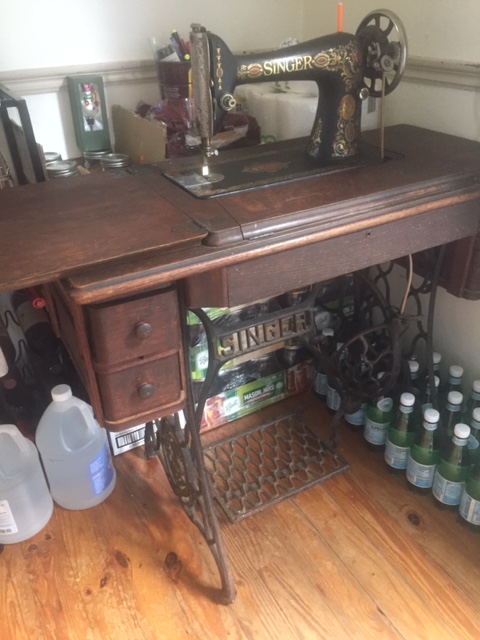
The cover plate for the bobbin mechanism was missing, so I went online to see what was available—dubious that anything would be. Surprise surprise. In the same way that some people are enthusiastic for old guns, or hand-powered tools, there is a small but tight circle of people who love old non-electric sewing machines. Our model was quickly identified from photos, and turned out to be made in 1911. The plate was easily available, along with advice on nursing the old machine back to health.
By now I had remembered that Singer had an enormous factory just outside Glasgow in Scotland that closed in the 1980s. Some more research gave me the history of Isaac Singer, its founder; he deliberately employed mostly women in his factories as he wanted to disprove the notion that they couldn’t handle the machining tasks involved!
I must admit that although I’ve always been intrigued by old technology and remember my mother having a treadle sewing machine, I was not expecting to have any success. The belt had broken and when I tried to get it moving with the hand wheel, it was so stiff it would hardly move. But the moving parts once again proved easily accessible online, and generous amounts of WD40 got things loosened up and moving freely again.
What’s fascinating is the mixture of skills involved that were required to make these beauties sing—er, sew: the cast iron treadle and wheel, another casting for the main top part, intricate metal machining of the needle and bobbin housings, and the clever wooden case holding it all together, complete with an internal peg to hold the machine in place during use.
Recently, Wendy’s mom gave her a modern electric machine to play with; apart from having a motor instead of a treadle, it proved remarkably similar to the old Singer. Once you have a good design, the only thing that changes is the power source. So I could easily see how the thread path worked and how the bobbin thread engaged with the upper one.
I also researched replacement belts which were surprisingly easy to obtain, too. That got us off the hook on one of the old machine enthusiast sites, which suggested using a pair of nylons. Wendy didn’t feel like sacrificing her winter tights.
Fitting the new belt was very finicky, as they come oversized, get cut to the correct length on the machine, and then the two ends have to be joined with a staple. I had to re-cut ours three times before I got it right, and apparently they stretch with use and have to be re-cut again. Wendy said it looked as though I were trying to fit a leash on a hyperactive cat.
Another missing part was the metal spike on top that holds the thread reel, which had broken off at some time. But I found that a round pencil was the correct diameter so cut a length and epoxied it in place. The pencil was orange, not a color Wendy cares for, so I think it will be weeks before she discovers it missing from her box of recreational coloring materials.
The only thing I haven’t done yet is actually try to sew anything, and that will undoubtedly be interesting. We are, of course, trying to avoid trips to the emergency room during the pandemic….
Finally – I was cleaning out our Dodge Journey today and there was the original bobbin cover plate lying on the floor, months after we transported the old girl from her old home to this one. I guess now we have a spare.

 Wendy Welch: Books, Yarn, Cats, Opioids