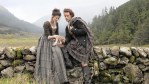
 Jack and I joined roughly half of the known world in watching a series called Outlander. We don’t have a television, but a friend recorded it for us and mailed the discs. For those of you who read this blog regularly, that was Susan, aka the late Hazel’s mom.
In addition to Susan’s having gone to some trouble, the music was done by the son of a fellow writer, Laura Kalpakian. (Bear McCrary is his name.) Although time travel romances are not our thing, Jack and I dutifully cleared a night in our pre-Celtic festival schedule and watched episode one.
We had such fun! Couldn’t tell you buggery about the plot, which seems to involve a porcelain doll lady of anorexic proportions and a craggy-faced boy-Scot, but we’ve been playing Spot the City for three episodes now.
The first we found was Falkland. As China Doll gazed wistfully into an antiques shop, Jack nudged me. “Isn’t that the violin repairman’s place, next to the tearoom across from the–”
The camera cut back, showing the “Mercat Cross!” (we shouted together).
Almost every medieval village in Scotland has a Market (“mercat”) Cross, a pole with a symbol atop it, recognized as the central point of the village square.
We identified Kynd Kittock’s Kitchen–oh the cups of tea and millionaire shortbread slices my friend Bun Brough and I have enjoyed there–and the backpacking hostel (bulletin board removed) in short order. We also got a quick view of the Palace before scenes changed to Dunkeld, then to Doune Castle. Only a couple of rooms remain in the ruins, so they kept using the same spaces from a different angle.
In episode three, things really got fun. By this time whasername was thrown back in time to just before the Jacobite Rebellion, and they were filming in various locations. We spotted the side of the cemetery in St. Andrews, the auld Kirk in Dunkeld, and then–
“Hey!” we both yelped, as the heroine bolted from a kitchen door hotly pursued by a broad-chested hairy Scotsman, “That’s Lindsey’s door!”
In Culross lives a dear friend of Jack’s, one Lindsey Portious by name. He’s quite the character – Scotland’s jaw harp champion, if that helps you get a handle on his personality.
Lindsey lived for years with his Mum, sadly now gone from us, in the Tron House, built 1619. He filled this historic home with assorted collections from his interests–popguns, antique musical instruments, heather-crafted jewelry. Lindsey makes bodhrans, those classic Scottish drums, and carves whistles. His home is one big garbage heap of creativity.
But his biggest claim to fame in that wild and crazy house was the kitchen door. Because the village was so old, over time Tron House had sunk as the street levels rose with repair after repair. In consequence, one takes a steep step downwards through the stone lintels of the doorway into the kitchen. Those who forget tend to get a sharp smack in–depending on height–the forehead (me, being short) the nose (for an average person) or the windpipe (basketball players).
It isn’t fun. I still remember the first time I “hit the wall”: stars and singing birdies and exploding dazzles of fireworks lit my brain. By the time I could gather voice to shriek, Lindsey had three Goody’s Headache Powders in a glass for me. My husband led me blindly to the table and put the glass in my hand.
So when we saw the delicate heroine spring like a greyhound from the door, we hooted with laughter. “Wonder how many times they had to practice THAT” we chortled, as the great bruiser of a Scots highlander exited behind her. He was a big man. “Did that guy get hazard pay?”
Quite honestly, we couldn’t tell you a single thing the series is about, but we are very much looking forward to episode four. Who knows where (or who) we might see?! We figure it’s just a matter of time until we spot one of our friends, plaidie wrapped about him, swelling a crowd scene.
 We’re kinda in a mad dash to the finish line here at the bookstore, headquarters for Big Stone Celtic. Our headliner is in residence, our signs are up, our theatre seats are out and ready… and we can’t get much of a blog post up today. But come visit the site Sunday, and we’ll have all sorts of photos and fun for you about the weekend. Meanwhile, if you can join us, the schedule is at www.bigstoneceltic.com, and on Facebook you can visit Big Stone Celtic Day. Sheepdogs, singing, and food, oh my!

