King’s Mountain?

Jack’s Wednesday guest post is, OF COURSE, late again –

A Dance called America – James Hunter

This isn’t really a book review, but I thought I’d better head this post that way, as much of what will come next is from my reading of this excellent and informative book.

The Battle of King’s Mountain is seen in this area and taught in US schools as a pivotal event in the American War of Independence. While that is certainly true, there is another way of seeing it that has a lot to do with centuries of Scottish history.

Everyone is familiar with the story of the ‘Scotch Irish’ and their settling in Southern Appalachia. These were the children of lowland Scots who themselves had moved to the north of Ireland and established plantations there. These children grew up to find they were unpopular in Ireland and with little economic prospects. So they moved to the ‘New World’ and specifically to Appalachia.

However Gaelic speaking highlanders from Scotland had already emigrated to the coastal regions of the Carolinas and Georgia earlier. These were relatively wealthy ‘tack men’ very high in the clan pecking order and just below the level of clan chief. Once in the Americas they established cotton and tobacco plantations (which is why Glasgow and Paisley became the tobacco and cotton ‘capitals’ of Europe).

The forces that met at King’s Mountain in 1780 comprised a loyalist army led by a professional British soldier – Major Patrick Ferguson, who was a Scots highlander, and a contingent of patriots who were mostly drawn from the Scotch-Irish immigrant population. On the British side, apart from Ferguson, the army was all volunteer, and they were mainly Gaelic speaking highlanders from the coast. The patriots were all volunteers and their leaders included many with Scots names.

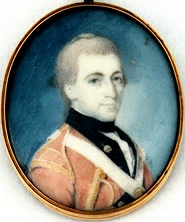
Patrick_Ferguson

Patrick Ferguson

It should be noted here that back in Scotland there had been centuries of clashes between the northern clans and the southern folk – a fault line between two distinctly different cultures!

I could never understand, however, why two lots of Scots that had been, effectively, forced out of Scotland would end up on opposing sides in what was at that time pretty much an English colony. It seemed odd to me.

But, as Hunter points out, the highlanders considered themselves ‘upper class’ and aristocratic before all else and saw the patriots as lower-class peasants who needed to be put in their place. So they aligned themselves with their ‘peers’ in London rather than their fellow countrymen. In doing so they inadvertently simply continued a long tradition of Scottish history – albeit in a foreign land.

Footnotes –

When the war ended with victory for the patriots, a great many of the highlanders who had been captured didn’t return to the Carolinas and Georgia. Instead they made new lives in Canada. At the present time there are more native Gaelic speakers in Canada than in Scotland.

The last native Gaelic speaker in North Carolina died in the late 1800s. He was a Presbyterian Pastor and an African-American!

Shortly after these events the highlands of Scotland suffered ‘The Clearances’, and this resulted in a much stronger feeling of solidarity between the Gaelic and Scots cultures, which has continued to strengthen down to the present.

Zip-line-pidedoodah

wendy zipZiplining wasn’t on my bucket list. When life presents you with an unexpected opportunity to do something you hadn’t planned for, I call it the Sieve List–those moments that demand “In or Out, you have five seconds to decide.”

My friend Susan is a master of seizing the moment. When my other friend Beth had talked me into The Zip, we agreed to meet at 2 pm outside our mountain lodge to drive down to the start point. Susan arrived to check in just as we were about to head out, and when I ran over to hug her hello, I joked, “I’m going on the new zip line in the park, so just wanted to hug you goodbye before I go.”

She said, “Wait a sec,” reached in and grabbed her purse, and climbed into Beth’s car. Susan doesn’t let any moments go by.

The first thing you need to know about ziplining is that the stool is scarier than the line. You go out on these tall platforms jutting off mountains, but not before the guides (in our case Tim the humorist and Dalton the straight man) hook you to a wire, to themselves, and at one point to a concrete block. You cannot fall off. It feels safe. But then they ask you to mount the stool (named for what it inspires people to do, joked Tim) and it’s high. Like two whole feet straight up. And you feel like you’re scraping the sky with your head, and there’s nothing to hold onto–unless you do like Beth and grab Dalton, but hey, he was cute. Then you’re standing on this tiny platform in the middle of the air–

–and catch your first full view of where you’re going. On the inaugural run, I was last. Just in case I wet myself, no one would see from behind, y’know? Once I got up on the stool and had a death grip on the tree behind me (Dalton having learned his lesson from Beth and keeping well back) I looked down into the gorge and thought, “Nope. Never mind. Changed mine.”

I looked back at Dalton, who was busy doing something with a big hook that looked all tangled in a rope. “Does anyone ever yell a terrible curse word as they launch?” I asked him.

He shook the hook and frowned at it, then glanced at me. “Haven’t seen that yet.”

“I’m surprised,” I muttered, staring at the canyon, and the thin, thin, wire spanning its deep, deep crevice.

“Well, it’s my first day, ” Dalton responded, and clicked the carabiner into place above my head. “You gonna jump or lean and slide?”

First day? 

He gave me a thumbs up. “You got this. When you’re ready to go….”

Bad word choice, kid. I checked that my conscience was clear with God, prayed for world peace, and jumped. Figured if it was my time, I should go big.

Here are some things you find out the first time you zippidedoodah. If you let go of the handles, you spin. If you stick your legs straight in front of you, you go faster. And if you keep your eyes open, you see the most amazing views. It was such fun, sliding over the water a few hundred feet below, watching it sparkle in the sunlight.

SusanWe got two more chances to practice the cannonball (tuck your knees to your chin) and starfish (let go and spread your arms and legs wide, screaming optional). It got easier with each jump–for the jumpers. Tim told us one of the things guides watch for is when people get cavalier or casual, and they don’t let anyone take anything for granted. It was Check One, Check Two, Zip Ready, Zip Go all the way down the lines.

If you get the chance to go zipping, I recommend it. And keeping your eyes open. You see the world in a whole new way.