
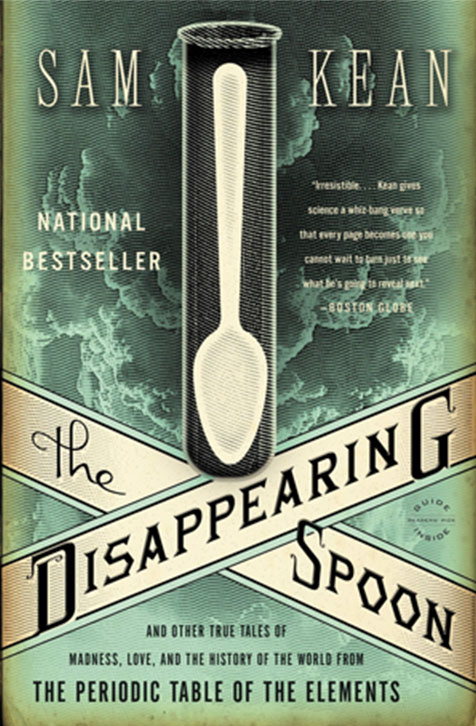
 My publisher and agent are constantly warning all their authors against books that lack a narrative arc. (In other words, the book is a series of short stories or anecdotes that don’t build into one big story.)
And I like these kind of books, although per their advice I’m trying not to write them. So I LOVED The Disappearing Spoon. It’s a series of anecdotes connected by the periodic table’s geography: the column of noble gasses, to one side of them the alkalis, to the other the acids, each bent on negating the other.
Kean makes explaining how atoms are put together simple, like Venus Flytrap once famously did on the sitcom WKRP in Cincinnati. He explains their layers, how they all want eight neutrons (I think it was neutrons) in their outer layer and every action they take is designed to make that balance happen. How these actions are interrelated to the rest of the universe, making stuff go or stop.
And then there are the funny stories about the scientists: bitter, driven, sweet, under-rated, over-rated: the people who discovered the stuff, and whether it made them happy or not. LOVE the people stories.
Then there are the the little bits like the title anecdote, about lab assistants making spoons out of gallium (which melts at 84 degrees) and serving tea with them. (Wonder how many wives, mothers, and girlfriends got gallium poisoning in the early 1900s? Wonder if there’s such a thing as gallium poisoning?)
But my favorite thing about this book is how he uses the periodic table columns to show how related elements are grouped, and how they are grouped next to things that are either very like or so opposite that they are inevitably paired in life and in our minds. It’s fascinating to dip into.
This is not a narrative you read in one sitting, but a bedside book you dip into. I’ve even read fluffy books between chapters of Kean’s denser, yet not frighteningly so, stories. He makes the ideas accessible, and the explanations simple. Like sitting down for tea with your favorite 9th grade science teacher. Just don’t use the spoon he gives you.
117 stars for The Disappearing Spoon, although a few of these have swift half-lives.
 Wendy Welch: Books, Yarn, Cats, Opioids