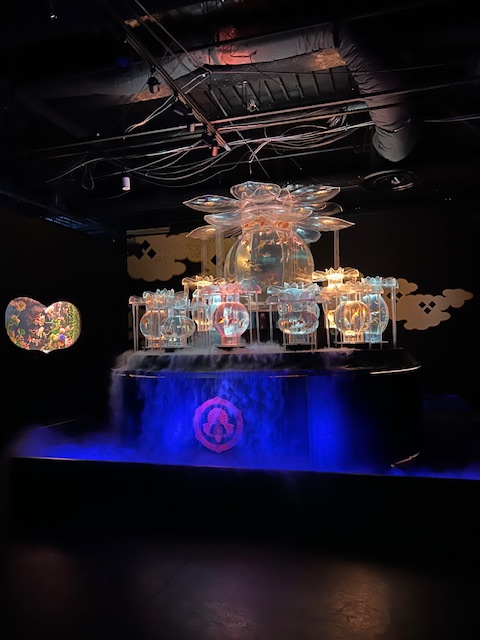
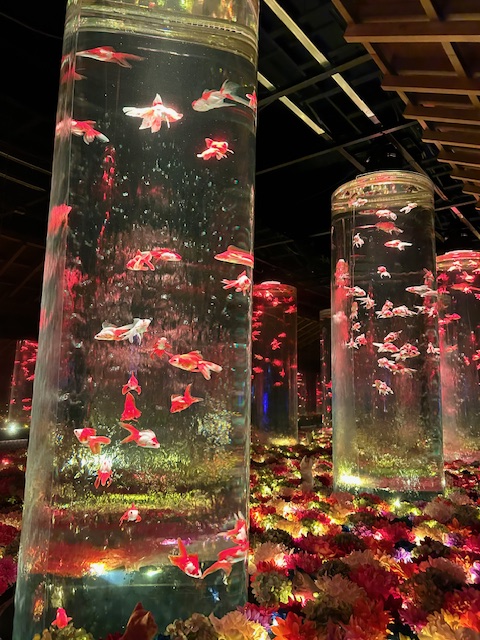
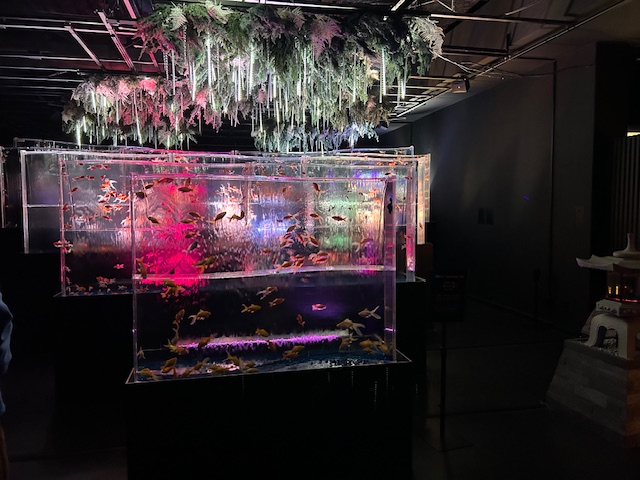
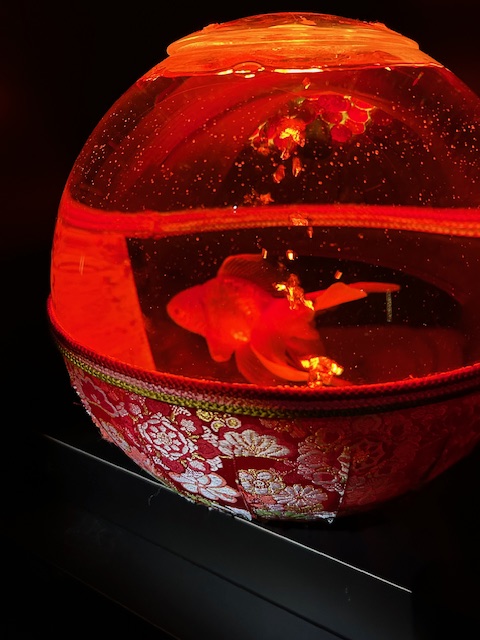
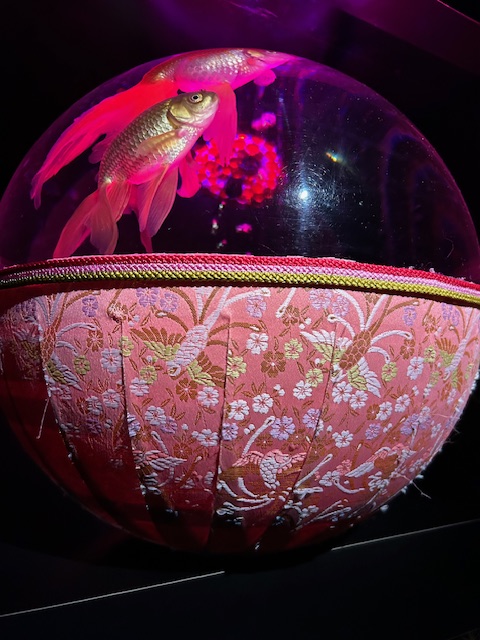
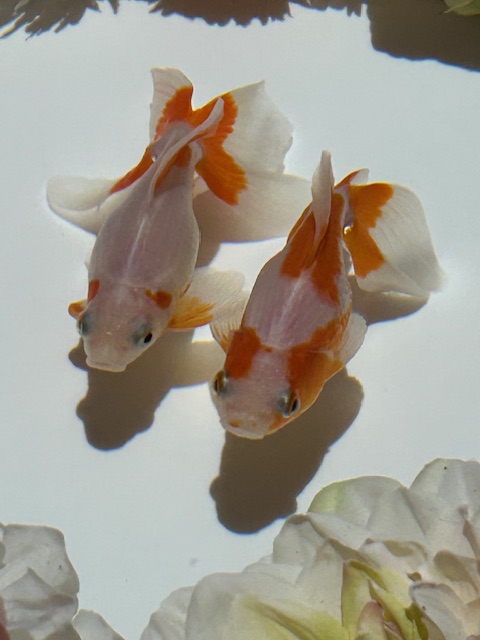
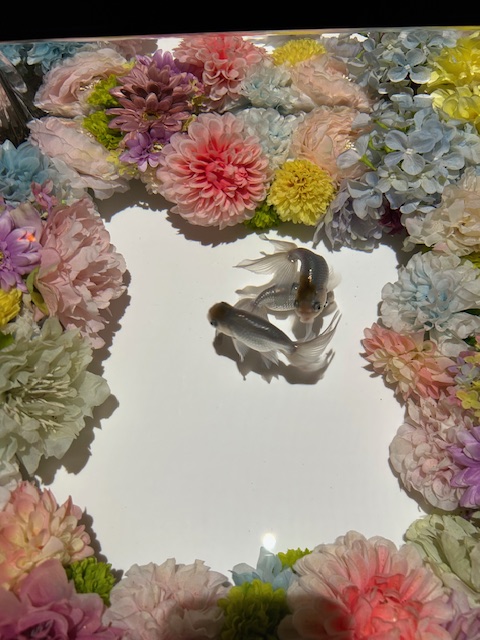
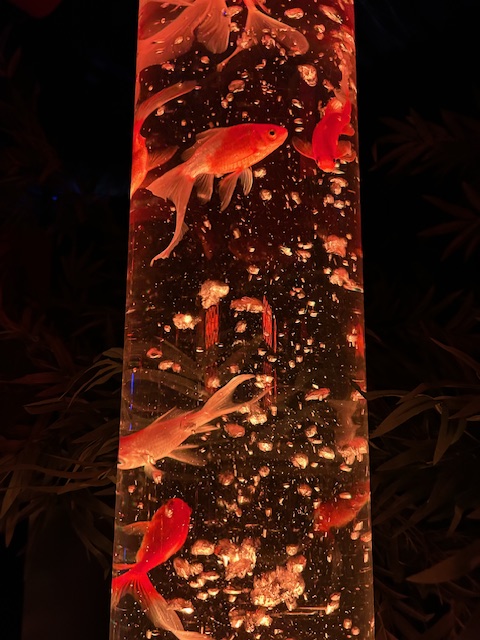
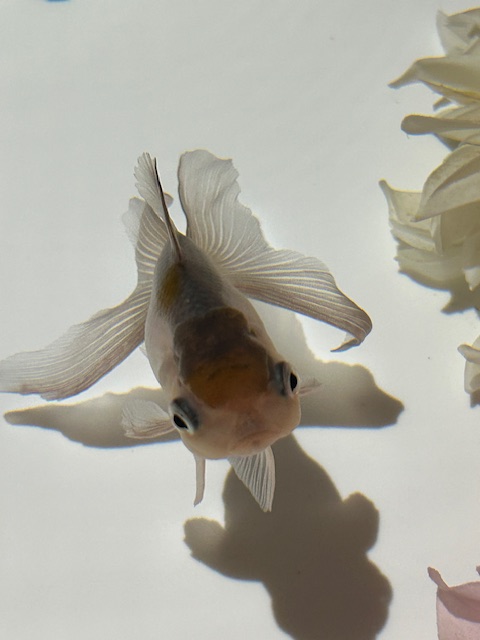
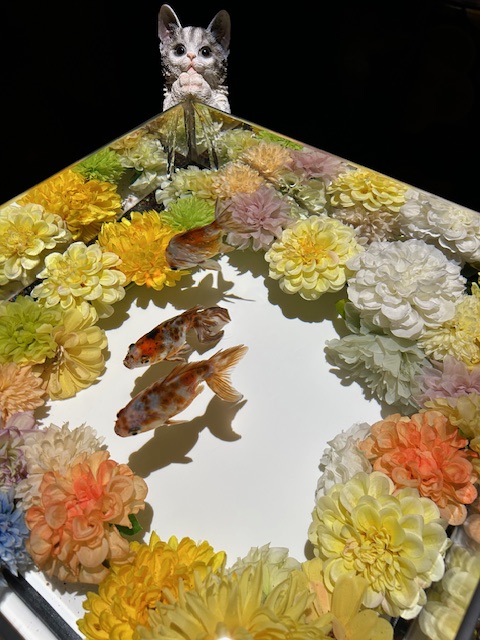
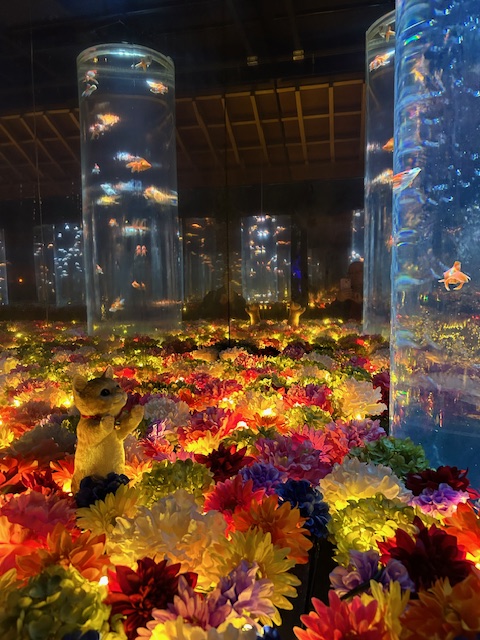
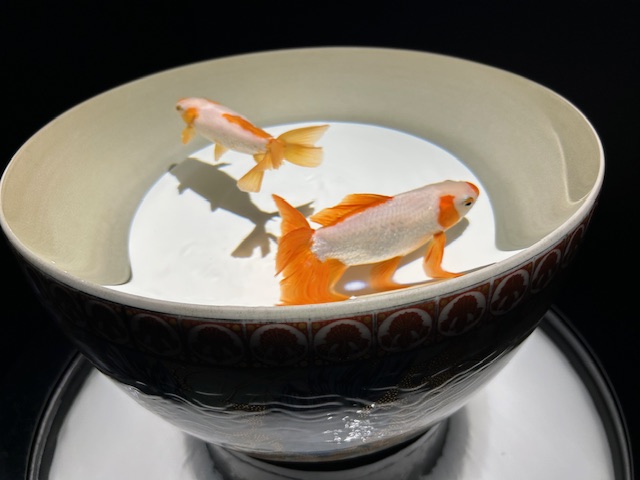
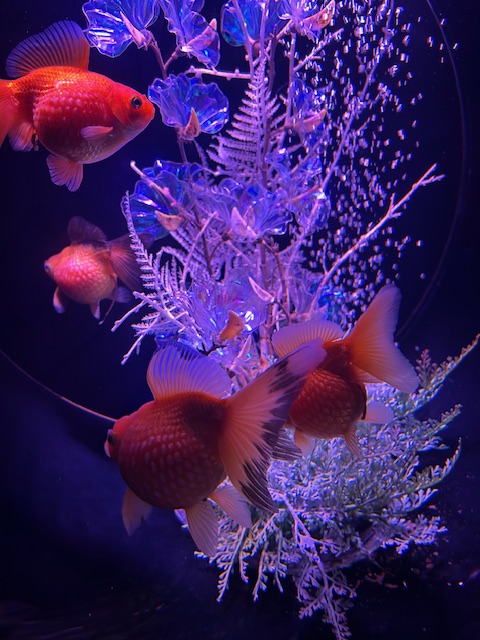
When Amelia suggested we go see the fish at a swank department store, it was more “sure, whatever” than yes please. But Amelia knew her target audience. What a beautiful, quintessentially Japanese display of living art.
Tranquility is an art form here, which is ironic given 30 million people live in Tokyo and most of them wear suits to work. It kinda reminds me of Appalachia: fast-paced work, slow communal leisure.
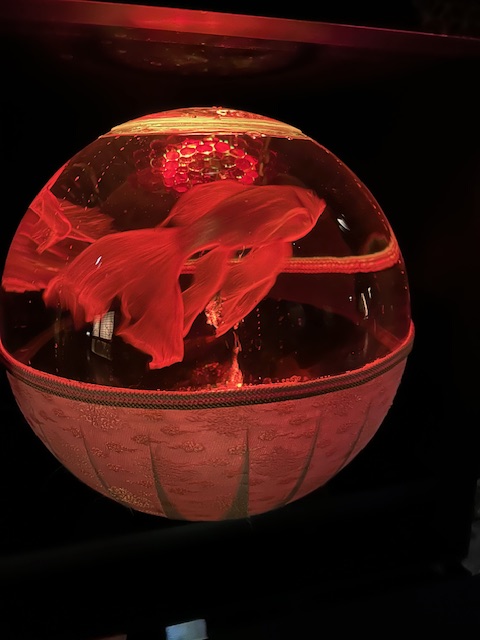
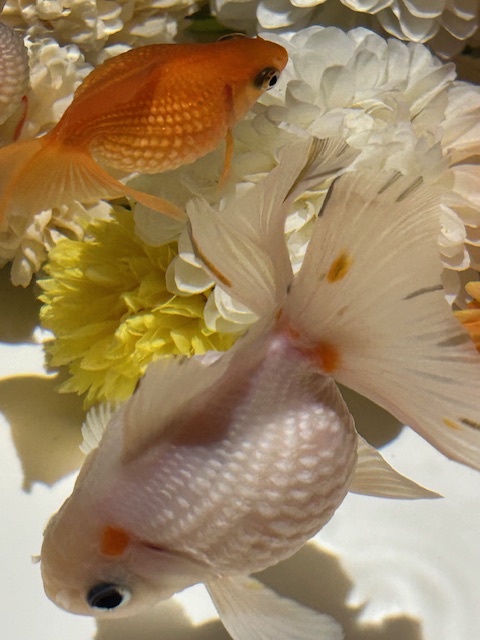
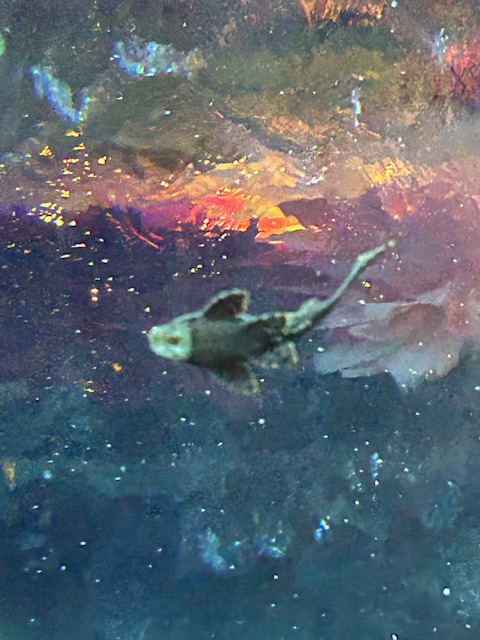
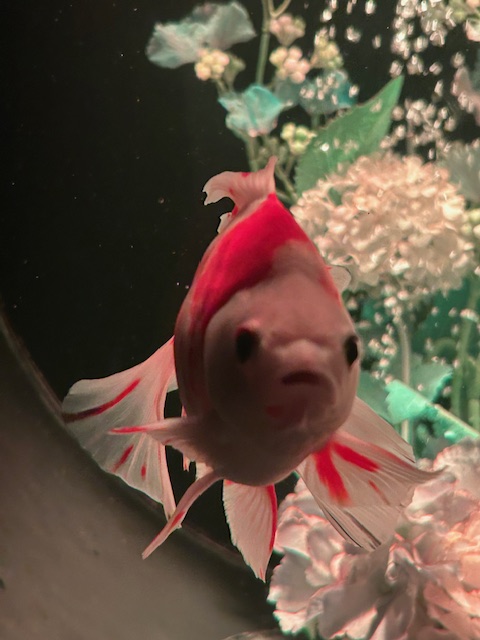
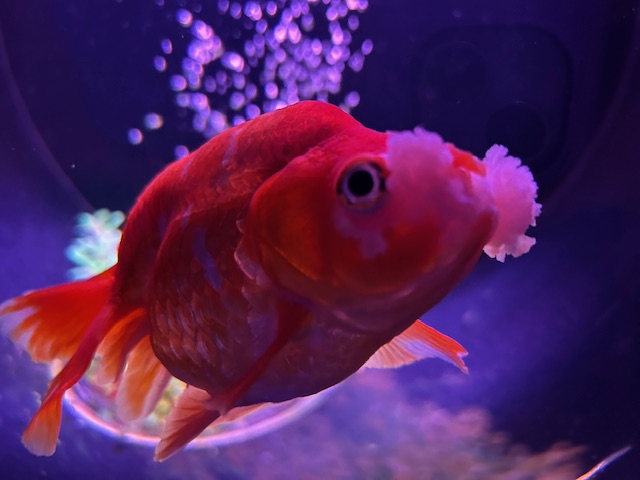
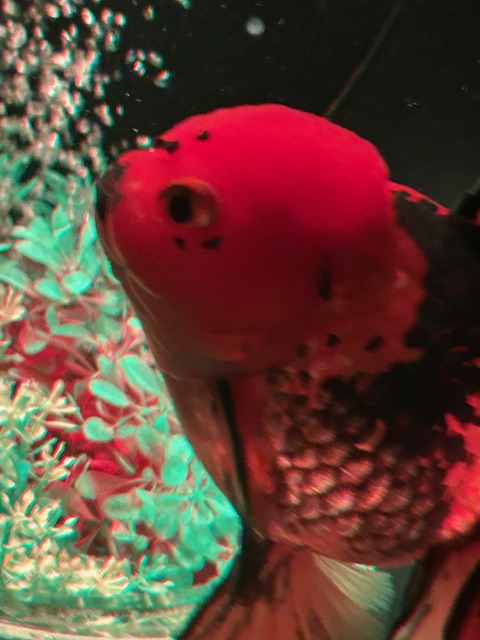
The pairing of lights, fish scales, fabrics, flowers, and music was sublime. Fish scales look a lot like embroidery. It was a lovely hour or two – I don’t know how long it was, but it was lovely.
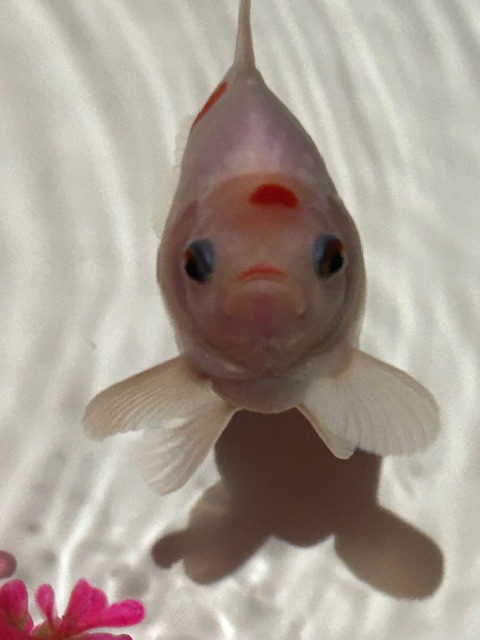
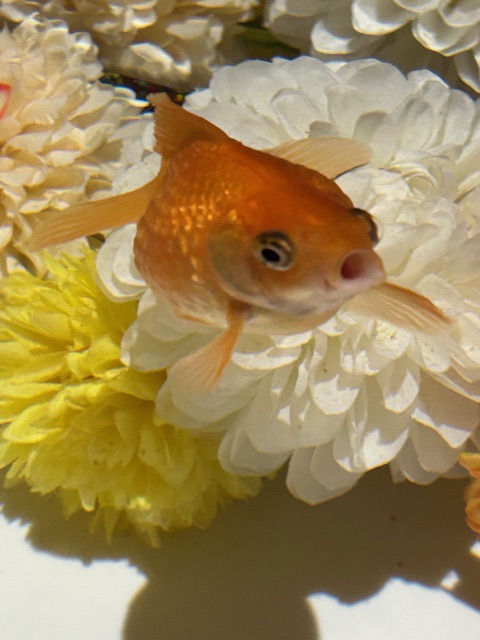
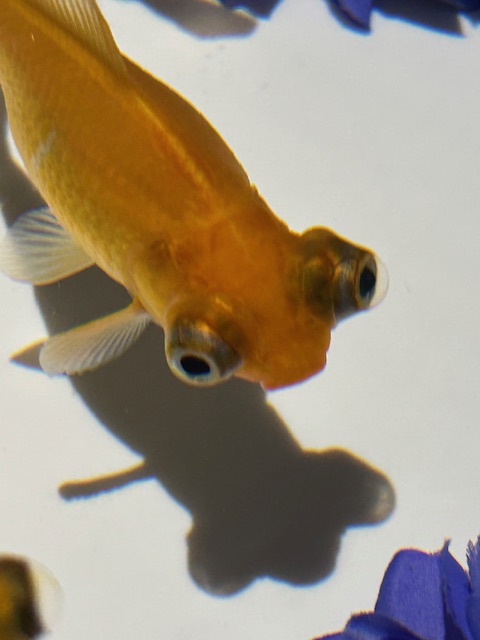
So I’m just going to post my pics of the goldfish display. I can’t put videos up but Jack might post some on his Facebook later. The music was definitely part of the scene. And should you feel inclined to caption any of the photos, just put the number of it in your comment. I was definitely hearing some ideas in my head.
And there was one stubborn red goldfish who was blooping merrily away until I trained my phone lens on him. Then he turned tail and began flouncing his at me. As if to say, “I know what you want, madam, and the answer is no.” I began moving around his square, blooping to him–until a large Japanese man shot me a look and rolled his eyes. Yes, well.
At that point the fish shook his tail at me in what can only be described as passive aggression tinged with sarcasm. I never did get a photo of him.
Here are the photos I got, and you can number your captions from left to right, top to bottom
1
8
9: I thought of this as the Wedding March
10: practicing their synchronized swim routine for nationals
So we got in this enclosed tube on a Wednesday in Maryland and emerged on a Thursday in Tokyo. Some kinda weird magic involving long hours in cramped positions and a never-ending stream of YELLOWSTONE episodes. (Lord, don’t people even try to talk out their problems anymore?!)
When we disembarked from the tube, it looked like a big frat party the morning after with lots of thin blue blankets. Why do people think flight attendant is a sexy job?
And we were in JAPAN!! We navigated the subway (which does not use colors to tell you which way to go, but the uses colored lines on maps, so that was a bad few minutes of confusion) and made our way down a street full of lanterns to the hostel – but to a bar first. Because, long flight. A gin and tonic and appetizer involving rolled up fish later, we set out confidently in the wrong direction (did I mention it’s my friend Amelia who is leading this exposition) and after a few fun discoveries arrived at and face planted in our hostel….
….and woke the next day raring to go! Amelia took me to a Donquix (named after Don Quixote). This is a shop intended to sell tourists thousands of Japanese souvenirs made in China. They are basically Buc-ees, twice as stuffed and ten times cuter. Think Buc-ees spray painted pink and gold, full of cute cat stickers and statuary.
But they sold a special Sakura Blossom edition of my favorite Japanese gin, so God Bless them.
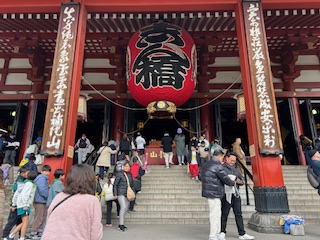
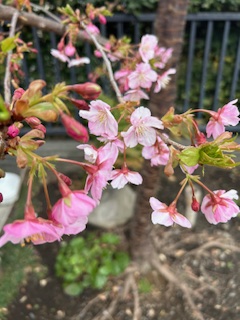
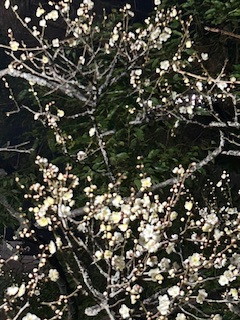
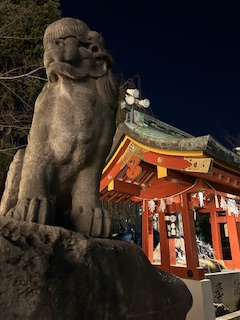
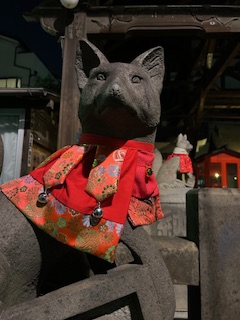
Amelia had lamented we would miss the cherry (Sakura) blossoms because of traveling in February, but there were multiple trees blooming near the ancient shrine and down by the river. The good thing about February is it keeps down tourists, says this tourist happily.
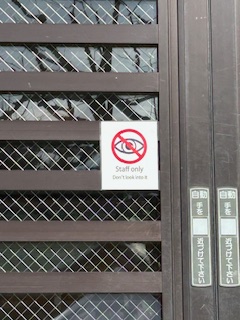
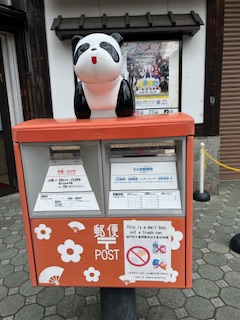
Japan is nice to tourists but you can tell the patience is fraying at the corners. Signs everywhere explain very patiently what good behavior looks like. Don’t look in here. Don’t chew in here. Walk on this side and ride your bike on that side. Dogs should not do what dogs do here (a personal favorite of mine). I thought Scotland did passive aggressive signs well, but Japan has raised it to an art form.
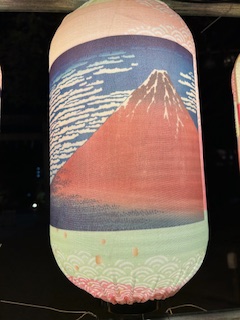
Speaking of art, Japan has elevated the humble KitKat to an art form as well. They have about 42 different flavors including Mt. Fuji (white chocolate with red jelly inside) Matcha (they look like Soylent Green wafers) and Strawberry shortcake. The mind boggles.
On a more sublime note, a lot of signs and grocery products have English below the Kangee characters, but the characters that make up traditional Japanese are a lot of fun if you have the basics of cracking their code. Once you know that “fire” looks like a guy raising his arms waving for help, and “person” looks like a box with a nose, you can find the heater in your room easily because it’s a person next to a fire.
Simple, really…..
Bike riders in Tokyo are experts at dodging people. I have felt their wind many times when I didn’t hear them approach, and never once even been brushed by the actual machine. If you move aside as they come toward you, the rider will quite literally bow their head as they pass. Bikers weave like swallows through busy streams of locals dutifully walking where the tiles on the pavement and signs on the lampposts say people should walk, and the tourists blithely standing in the middle of the bike lane taking selfies. At least one guy saw the bike coming because he and his girlfriend were taking a selfie and it photobombed. Only time I’ve heard someone yell on the street.
There’s no trash (or trash cans) on the street. There’s no eating on the street. We walked under one bridge where homeless people had set up cardboard cribs for themselves, up against the sides of the wall. We have seen exactly four homeless people sleeping in a city larger than New York.
The first day in any foreign land, you walk around with your jaw hanging open, trying foods you point to and dodging whatever you don’t know to look out for. Tomorrow (er, today – we are 14 hours ahead of y’all back there in America and 7 hours ahead of the United Kingdom) we will explore further afield.

 Wendy Welch: Books, Yarn, Cats, Opioids