
The Monday Bookshelf

This week’s Monday Book is the 1847 Proceedings of the Virginia House of Delegates. I spent the weekend decoupaging a bookshelf with it.

Creativity is the product of sublimated aggression. And Saturday I just needed to do something different with my life. So I papered a bookcase–literally.

Some of the pages were bills and their readings. Some were budget reports. The state was $4 million in debt in 1847. Some were assessments of income on how they were making up that revenue. Taxes and such. Income from criminal properties seized by the state. Which included people.

The second shelf holds the two-page report of female prisoners, ages 14-66, by number of women in each age bracket, and the occupations they had been put to work in at the prison. Several spinners, some dyers, a couple of weavers, etc. I put it face side up, where books would sit on top of it but I could look over and just see the entry on the edge of the shelf: 14-20, 6, spinners, income–and then it’s lost under the next page.

Ezekiel 34: 1-4 discusses shepherds who tend the sheep entrusted to their care, versus those who strip them of their wool, their dignity, their lives:

The word of the Lord came to me: “Son of man, prophesy against the shepherds of Israel; prophesy and say to them: ‘This is what the Sovereign Lord says: Woe to you shepherds of Israel who only take care of yourselves! Should not shepherds take care of the flock? You eat the curds, clothe yourselves with the wool and slaughter the choice animals, but you do not take care of the flock. You have not strengthened the weak or healed the sick or bound up the injured. You have not brought back the strays or searched for the lost. You have ruled them harshly and brutally.

A friend said I should have burned the book. Nope. It’s a coded message that will sit in the shelf for all time: this is why we vote. Justice for all, or justice for none; make space for the voiceless, or expect to lose your voice. No matter who wins–or when the winner is declared, by whom–I will know that message on the shelf.

Vote carefully.
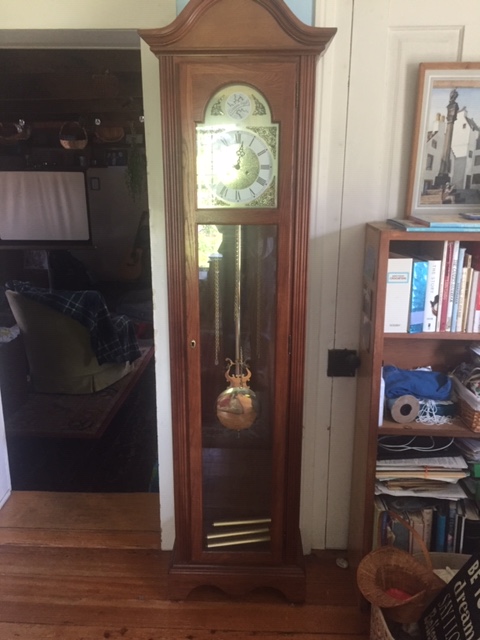
The Times they are – – –

Jack fails miserably again to get his Wednesday guest post up on time – –

Wendy and I have been ‘zooming’ with a few friends weekly ever since the pandemic closed things down. The group consists of David and Susan in North Carolina, Beth and Brandon in Big Stone Gap, Virginia, ourselves in Wytheville, Virginia, and Barbara and Oliver in Edinburgh, Scotland.

We meet on Sundays at 9 am but because of the five-hour time difference that’s 2 pm in Edinburgh. Except last Sunday was an exception because the clocks in the UK had changed on Saturday night. They don’t change here until this Saturday, so for just one week the time difference is four hours! Being half American and half Scots I was vaguely aware of the anomaly so I checked on line and – yes, this was the week of the lesser hours! A hasty last minute e-mail to Barbara saved the day – and the meeting.

But it got me curious about the whole business of changing the clocks twice a year – Spring forward and Fall back. So I did a bit of research and found some fascinating stuff. Some countries simply don’t do it at all and in many that do there’s a debate about whether to continue with it. That debate is no more heated than in the UK, and the problem is that most of the population is in south or central England where they would not see much difference in winter, whereas folk in Scotland definitely would. The European Union has a plan to stop changing the clocks in a couple of years’ time, so a strange result of ‘Brexit’ is that, if the UK sticks with clock changing, then for six months there will be an hour’s difference between Northern Ireland (in the UK) and the Irish Republic (in the EU).

By now I was well and truly hooked on the history of time-keeping and how the world arrived at any notion of ‘standard’ time. It turns out that the arrival of the railroad around the world had a lot to do with it. Prior to that local areas kept their own time, often just within the sound of church bells or a day’s travel on foot or by horse. It was the arrival of trains and reliable clocks and watches, not to mention the telegraph, that brought the need for standardized time. Since Britain owned most of the world then Greenwich Mean Time (GMT) in London became the default standard with all other time zones and/or clock changes measured relative to GMT. Although wasn’t it Mussolini who made the trains run on time?

Of course the arrival of the internet and the ability to speak to and see people on the other side of the world brings me back to what kicked off my interest in the first place – this Sunday we’ll be back to the usual five-hour difference!