
Sleeping on Iron(y)ed Sheets

Anyone who travels for work—book tours, corporate sales, what have you—knows the exhaustion of sleep in strange beds. Each city this book tour has taken us to—New York with its taxi honk operas, Philadelphia and the late night peace protest sing-alongs, Charlotte with that steady humming undercurrent of Big Money—we’ve hunkered into provided beds, covers pulled around our ears, and reached for the dubious slumber of country mice away from home.

So we were delighted when a three-day break let us sleep in our own little beds again. We arrived back at the bookstore, admired Andrew the Shopsitter’s latest innovations (this guy is a gem) and fell into bed.

Then Jack began to cough. And cough and cough and cough, the kind that medical professionals would call “unproductive,” what moms call “dry tickly.”

Or just bloody annoying. The sound of one’s spouse hacking up a lung in small pieces is heartrending, but for someone having her first night in the ol’ home place since Oct. 5th, it’s also bad timing. He tried NyQuil, extra pillows, throat lozenges, as I lay by his side in supportive wife mode, hoping. About 3 in the morning, Jack turned to me. “Go sleep in the living room. Your patient, understanding silence is getting on my nerves.”

The next day Jack announced that after I’d left, he’d stopped coughing.  “Which means the cabin will be okay.” I had a media interview in the early evening, but then we planned to flee to our two-room shack in the woods—so far back that Internet and phone service are not available, and if we hear a motor, it’s coming to us—until time to leave for Asheville Sunday.

The interview ran long because Kim (a writer for the paper in Southern Pines, NC) and I really hit it off, so we got down to the cabin about 9 pm—or, as my friend Heather says, about half an hour past my bedtime. We spooned into slumber beneath the comfy duvet…

…and woke at 1 am to a noise reminiscent of The Blair Witch Project.

“Dafuq?” my husband more or less mumbled, snatching up a nearby hardback and preparing to defend me to the last page. Book in assault position, he traversed the perimeter.

A homegrown girl, I knew. “It’s a mouse.” Locating the noise, I banged on the dresser and began opening drawers to reveal the (now empty) nest. We crawled back into our home turf bed.

The mouse crawled back to hers. And began to install a bowling alley. I got up and banged the dresser. Silence—and then a single acorn came spewing over the top of a drawer, as if fired from a cannon.

I went back to bed. The mouse invited friends over, one of whom played saxophone. There was also a bagpiper, and I think an electric keyboard player. I rose, banged the dresser, and shouted, “Lissen, if you little bastards don’t stop, I’ll call the law, do you hear me? There are noise ordinances! It’s 4 in the morning!”

My husband switched on the bedside lamp and peered at me closely. “What?” I snapped.

“Oh, nothing, nothing,” he said, smiling in a don’t-hurt-me way. “Come back to bed, darling. You’ve had a long couple of weeks.”

At 5 am the mouse partiers headed home. We heard their car doors slam, the loud farewells, the final blasts of the party horns and noisemakers.

That afternoon Jack and I carried the drawer with the cozy nest outside, turned the drawer upside down and watched a large, sleepy field mouse surface, blinking in the sun. “Dafuq?” it mumbled, staring bleary-eyed at us before racing into to the woods.

I’m not proud of this, but at that moment, if I’d had a saxophone, I’d have played it in triumph. But Jack and I then carried the sheet nest over to the rock whence the mouse had fled and left it as a peace offering. Sleep and let sleep.
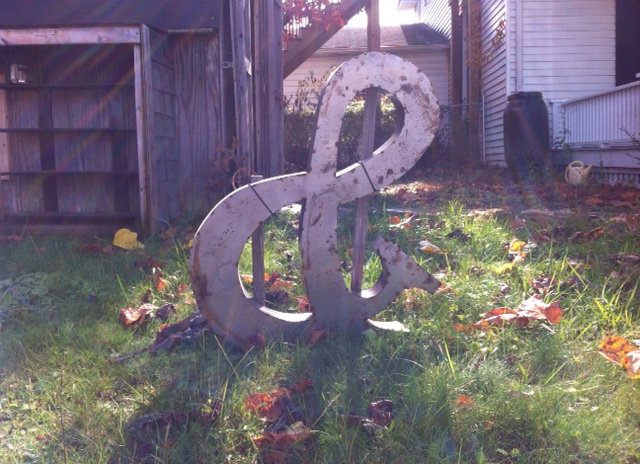
Ampersand & Lawn Ornaments

After the first leg of  Wendy and Jack’s book tour they returned with books, pictures, the leftover shortbread and one giant metal ampersand. It’s now set up in the front yard, after much deliberation over its placement. And it’s a constant reminder that ampersands are super super weird. In fact, we spent a good ten minutes debating if it was facing the right way. We’ve certainly all seen plenty of ampersands (I can’t really speak for Jack and Wendy… maybe they’ve managed to avoid them thus far). But it’s just one of those shapes that’s complex, but not quite complex enough to be memorable, so it slides right out of your mind.

Definitely facing the right way… right?

Ampersands started as a form of typographic ligature, which is a combination of two different graphemes (thanks Wikipedia!). In the case of the ampersand the two graphemes are the letters E and T, and the ligature is formed when the two are smushed together (yeah, I didn’t really see it either, but check out the ampersand in fonts like Trebuchet and you’ll get the picture). “Et” is Latin for “and,” so ampersands got their start when a bunch of Romans got too lazy to write out the full word. Which is really lazy, considering they had already worked out an “and” with one less letter than ours.

Not to sound too much like a late-night English student a bit too drunk on “literary theory”, but I’m about to act like a late-night English student a bit too drunk on literary theory. What’s cool about the ampersand is that its appearance actually matters. It’s not a letter at all, but a picture. Replace the letter “A” with “#” and nothing changes. The appearance has nothing to do with the meaning. But take two meaningless symbols and push them together into an ampersand you have something  with a meaning that only exists when it looks approximately the way it’s meant to look.

AND The Little Bookstore of Big Stone Gap

And since we love reading into pictures, the ampersand has become more than just a smushed together “E” and “T.” The best example where we’ve given it a meaning for itself, separate from “and,” comes from screenwriting, where the ampersand suggests direct collaboration, whereas “and” means one writer, followed by a second rewriter. If I pop “by Michael Crichton & Andrew Whalen” on my screenplay for Jurassic Park 5: Whatever Happened to Nedry’s Shaving Cream Can? it means that the two of us have collaborated via seance. We are equal partners. But if my Jurassic Park 5: Whatever Happened to Nedry’s Shaving Cream Can? screenplay is instead by “Michael Crichton and Andrew Whalen” it means that I took something Crichton had done and rewrote it for myself without consulting him. Take away my ampersand and I go from being the brilliant necromancer co-writer of the summer 2016 blockbuster hit to being the lonely author of rip-off fan-fiction that will never see the screen.

If I were to draw some sort of conclusion out of this, then I would say that the ampersand is an appropriate symbol to have in metal on the front lawn of your bookstore. Letters just sit on the page and we make them real as we interpret them in our heads. Writers create on the page and the readers pick up these pieces and rebuild the ideas for themselves.  Staked down on the front lawn of Tales of the Lonesome Pine, alongside a toilet overgrown with vines, a plastic dimetrodon, and several stone animals wearing wire-frame spectacles, the ampersand is a kind of visual re-creation of the first step in this process, where we take simple scratches and begin to combine them into an entire visual language that can impart meaning, feelings, or hovercraft chases through space-stations. The ampersand is not a letter or an idea: it is a simple statement of how the former becomes the latter.