
The War is Aimed the Wrong Way!

Jack’s Wednesday guest post –

There’s something really shocking and sad when someone you know takes his own life.

JB was a laid back friendly guy who was always ready to do a favor for anyone. The outpouring of messages about him on FaceBook all testify to that. Actually, around the time he took his life, he was meant to be meeting with us to discuss work he was going to do on our front yard. Only a few weeks ago he power-washed our front porch.

We did know something about the particular struggle he was waging–not an unusual one around here, either. It has been described as an epidemic and involves prescription drugs – opioids.

Just a few weeks ago Wendy’s annual medical conference focused on that very epidemic and the need for medical professionals to be much more aware of alternatives to highly addictive pain-killers. But there’s a very active economy around all this, and many people making a lucrative living from other folks’ misery.

I had a friend in Scotland many years ago who went to some considerable lengths to end his life because he decided his family would be better off without him. He was wrong about that, but I also believe it must have felt a courageous act from his point of view. I feel exactly the same way about JB – he felt he had slipped again and couldn’t in the moment of despair see any other way to free his family to get on with their lives.

What I can’t see is why the “War on drugs” is aimed at the wrong end of the telescope. Where is the accountability for the over-prescribing done in America, the pills that flow free and easy and the lack of accountability for the producers who marketed them, even tested them in some cases, on a population that tended to do hard labor jobs. Why is it now simpler to get pain meds than a job in this part of the world? And why is the War on Drugs blaming people like JB for being “losers” rather than the pharma executives who took advantage of us and then walked away, unaccountable?

Today is Mental Health Day and, clearly, anyone driven to suicide by a habit should have received more support by professionals, community and friends. Addiction is an illness, not something shameful and certainly not a crime. JB deserved better. The outpouring from his friends in this community stand as a living testament to how far his life reached.

Rest in peace Jessee; the rest of us will see that the people who did this to you, don’t.
King’s Mountain?

Jack’s Wednesday guest post is, OF COURSE, late again –

A Dance called America – James Hunter

This isn’t really a book review, but I thought I’d better head this post that way, as much of what will come next is from my reading of this excellent and informative book.

The Battle of King’s Mountain is seen in this area and taught in US schools as a pivotal event in the American War of Independence. While that is certainly true, there is another way of seeing it that has a lot to do with centuries of Scottish history.

Everyone is familiar with the story of the ‘Scotch Irish’ and their settling in Southern Appalachia. These were the children of lowland Scots who themselves had moved to the north of Ireland and established plantations there. These children grew up to find they were unpopular in Ireland and with little economic prospects. So they moved to the ‘New World’ and specifically to Appalachia.

However Gaelic speaking highlanders from Scotland had already emigrated to the coastal regions of the Carolinas and Georgia earlier. These were relatively wealthy ‘tack men’ very high in the clan pecking order and just below the level of clan chief. Once in the Americas they established cotton and tobacco plantations (which is why Glasgow and Paisley became the tobacco and cotton ‘capitals’ of Europe).

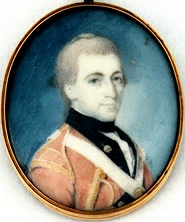
The forces that met at King’s Mountain in 1780 comprised a loyalist army led by a professional British soldier – Major Patrick Ferguson, who was a Scots highlander, and a contingent of patriots who were mostly drawn from the Scotch-Irish immigrant population. On the British side, apart from Ferguson, the army was all volunteer, and they were mainly Gaelic speaking highlanders from the coast. The patriots were all volunteers and their leaders included many with Scots names.

Patrick_Ferguson

Patrick Ferguson

It should be noted here that back in Scotland there had been centuries of clashes between the northern clans and the southern folk – a fault line between two distinctly different cultures!

I could never understand, however, why two lots of Scots that had been, effectively, forced out of Scotland would end up on opposing sides in what was at that time pretty much an English colony. It seemed odd to me.

But, as Hunter points out, the highlanders considered themselves ‘upper class’ and aristocratic before all else and saw the patriots as lower-class peasants who needed to be put in their place. So they aligned themselves with their ‘peers’ in London rather than their fellow countrymen. In doing so they inadvertently simply continued a long tradition of Scottish history – albeit in a foreign land.

Footnotes –

When the war ended with victory for the patriots, a great many of the highlanders who had been captured didn’t return to the Carolinas and Georgia. Instead they made new lives in Canada. At the present time there are more native Gaelic speakers in Canada than in Scotland.

The last native Gaelic speaker in North Carolina died in the late 1800s. He was a Presbyterian Pastor and an African-American!

Shortly after these events the highlands of Scotland suffered ‘The Clearances’, and this resulted in a much stronger feeling of solidarity between the Gaelic and Scots cultures, which has continued to strengthen down to the present.