
Jack’s Wednesday guest post is, OF COURSE, late again –
A Dance called America – James Hunter
This isn’t really a book review, but I thought I’d better head this post that way, as much of what will come next is from my reading of this excellent and informative book.
The Battle of King’s Mountain is seen in this area and taught in US schools as a pivotal event in the American War of Independence. While that is certainly true, there is another way of seeing it that has a lot to do with centuries of Scottish history.
Everyone is familiar with the story of the ‘Scotch Irish’ and their settling in Southern Appalachia. These were the children of lowland Scots who themselves had moved to the north of Ireland and established plantations there. These children grew up to find they were unpopular in Ireland and with little economic prospects. So they moved to the ‘New World’ and specifically to Appalachia.
However Gaelic speaking highlanders from Scotland had already emigrated to the coastal regions of the Carolinas and Georgia earlier. These were relatively wealthy ‘tack men’ very high in the clan pecking order and just below the level of clan chief. Once in the Americas they established cotton and tobacco plantations (which is why Glasgow and Paisley became the tobacco and cotton ‘capitals’ of Europe).
The forces that met at King’s Mountain in 1780 comprised a loyalist army led by a professional British soldier – Major Patrick Ferguson, who was a Scots highlander, and a contingent of patriots who were mostly drawn from the Scotch-Irish immigrant population. On the British side, apart from Ferguson, the army was all volunteer, and they were mainly Gaelic speaking highlanders from the coast. The patriots were all volunteers and their leaders included many with Scots names.
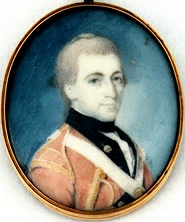
Patrick Ferguson
It should be noted here that back in Scotland there had been centuries of clashes between the northern clans and the southern folk – a fault line between two distinctly different cultures!
I could never understand, however, why two lots of Scots that had been, effectively, forced out of Scotland would end up on opposing sides in what was at that time pretty much an English colony. It seemed odd to me.
But, as Hunter points out, the highlanders considered themselves ‘upper class’ and aristocratic before all else and saw the patriots as lower-class peasants who needed to be put in their place. So they aligned themselves with their ‘peers’ in London rather than their fellow countrymen. In doing so they inadvertently simply continued a long tradition of Scottish history – albeit in a foreign land.
Footnotes –
When the war ended with victory for the patriots, a great many of the highlanders who had been captured didn’t return to the Carolinas and Georgia. Instead they made new lives in Canada. At the present time there are more native Gaelic speakers in Canada than in Scotland.
The last native Gaelic speaker in North Carolina died in the late 1800s. He was a Presbyterian Pastor and an African-American!
Shortly after these events the highlands of Scotland suffered ‘The Clearances’, and this resulted in a much stronger feeling of solidarity between the Gaelic and Scots cultures, which has continued to strengthen down to the present.
 Wendy Welch: Books, Yarn, Cats, Opioids