Regan’s Halloween Recommendations

1951 – The Deserts of Iraq

A dashing explorer-priest is conducting a study of ancient relics when his archaeological team uncovers a statue of the Sumerian demon Pazuzu.  A confrontation with evil is inevitable.

2012 – Tales of the Lonesome Pine Bookstore

Andrew Whalen, shopsitter, is woken by clanking and rattling noises in the attic. He investigates, hoping to find Halloween decorations and not to find demons. He is disappointed on both fronts.

But as Andrew encounters the horror within he discovers that it’s not the Sumerian Pazuzu at all, but a transmigrated manifestation of Andrew’s own Netflix Instant Queue, and the horror movie that had awaited him.

This is getting complicated.

Now Andrew is possessed by the spirit of  Regan, a young girl, who is herself possessed by the demon Pazuzu and is ALSO fictional.

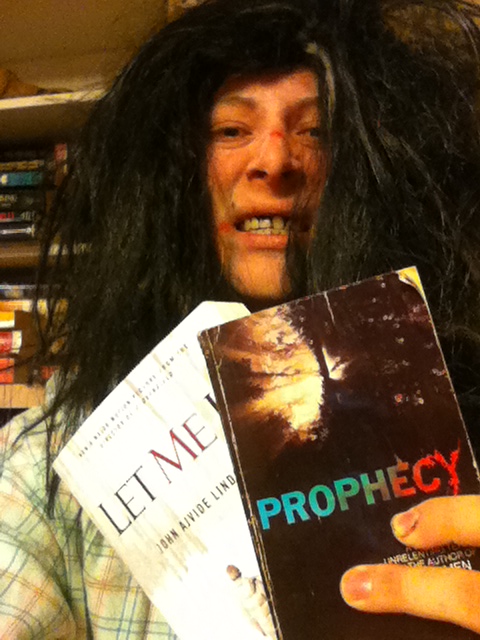
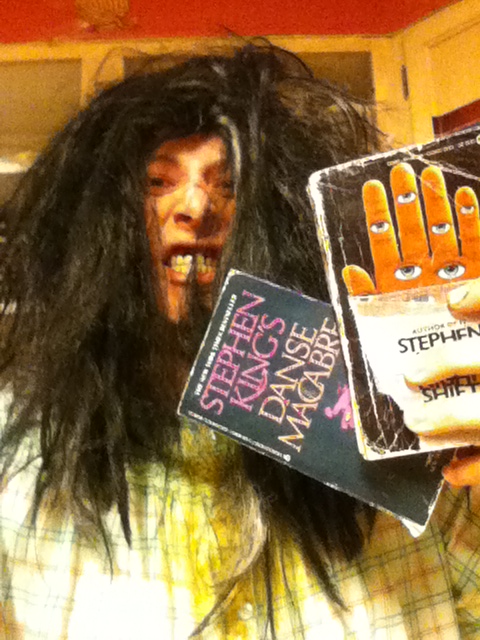
Phwew, this is a mess. And totally not an excuse to wear a night-gown all day and eat split-pea soup. Luckily, this particular possession arrived just in time for Halloween! And Regan has recommendations from the shelves. Take it away evil-spirit-movie-demon-girl:

While William Peter Blatty’s The Exorcist is way better, the sequel Legion has some fun moments. More police procedural than horror, it’s never as scary as the original, and has far less ME!

Full of supposedly true tales as told by truckers and motorists, the Book-on-CD Trucker Ghost Stories is occasionally chilling, but more often just plain fun.

Ok, I’ll admit. I haven’t read either of these. But I’ve heard good things about Let Me In and the Swedish film adaptation Let The Right One In is the best vampire movie since Near Dark. As for Prophecy… if it’s anything like the movie than it waffles between environmental preaching and gory silliness in the most charming and 1970s way imaginable.

And no Halloween list would be complete without creepy ol’ Mr. King, so I’m recommending his short story collection Night Shift, which includes the story that heart-attacked 13-year-old Andrew, “The Boogeyman.” Plus, there’s no better primer to horror as a genre than his nonfiction Danse Macabre.

Oh, geez. This is just so exciting. I spewed up all my demon gunk.

Happy Halloween!

Whuffling Through the Social Sciences

IN THIS EPISODE: Shopsitter Andrew Whalen gets more than he bargained for while trying to impose a little order on life’s chaos….

Things got a little too real today when I tore apart the “-Ology” bookshelf and set out to rebuild it. This shelf contains folklore, sociology, anthropology, self-help, career advice and research best practices.

At first reorganizing was fun. In a confusing world it can be comforting to establish hierarchies and draw borders. This is the appeal of the low-stakes nerd debate. Does it matter if Kirk or Picard were the better starship captain? No, but it feels good to put things in order (this one always seemed easy to me: one survived the reign of Kodos the Executioner, has the middle name Tiberius, passed the Kobayashi Maru test, and defeated conqueror-of-all-Asia Khan Noonien Singh… the other is Picard).

But some chaos cannot be cornered, tagged and boxed. Some chaos can only be whuffled, which is the word I made up to describe the sensation and action of bottling various fogs. Or the word I thought I had made up until I typed it into a search engine and found it used to describe sniffling, gentle affection and thankless online forum moderation. If we’re going by my definition (not endorsed by the Internet) it’s a feeling that accompanies so much of what we try to set in place. And the more I stared down the “-Ology” shelf, the more I begin to think the whole world is made of whuffle.

Yes, whuffle is verb, adjective and noun. It’s very versatile.

Before the “-Ology” shelf this uncertainty seemed very abstract to me. It came up primarily when considering genre. Is it fantasy just because there are swords? Is it sci-fi just because there are spaceships? Read Gene Wolfe’s The Book of the New Sun and get back to me. Welcome back. See what I mean? And that’s before we get into odd-balls like Gabriel Garcia Márquez, Thomas Pynchon, and Margaret Atwood. No wonder people just gave up and invented the term speculative fiction.

The “-Ology” shelf was supposed to be different. It represents entirely separate realms of human knowledge! It’s like a UN of social sciences, each field a tiny nation-state with its own territories and agendas.

But my distinct borders kept getting knocked down. What to do with Typetalk, which purports to be a study of the Myers-Brigg Type Indicator, but has self-help cover language promising to aid in determining how you “live, love and work”? Things only blurred more from there. When is a study on families anthropology and when is it sociology? Are Coping with Difficult People and Coping with Difficult Bosses really so different that they should be three shelves apart, one in sociology, the other in career guidance? ARGH.

So I started fresh, with a new theory. I could arrange the shelf like a continuity. There was a spectrum at play, beginning with psychology: the individual opening up onto the family, expanding into the society, then reaching out to other societies and forms of governance before finally drilling back down into the individual stories each society treasures. Brain to Folklore, with all of human experience in between. Made total sense for like two seconds. But things just got worse. And by the end I had almost convinced myself that Life-Span Developmental Psychology and Normative Life Crises was interchangeable with Folklore in the English and Scottish Ballads.

I look at the shelf now and see nothing but whuffle. No matter how hard we try (I’m looking at you, Dewey, with all your decimals) nothing exists entirely separate and apart. Categories are cool, but they are never definite. All things interlock and nothing is simple. But as maddening and confusing as that can get for the bookshelf organizer, it probably makes for a more interesting world.