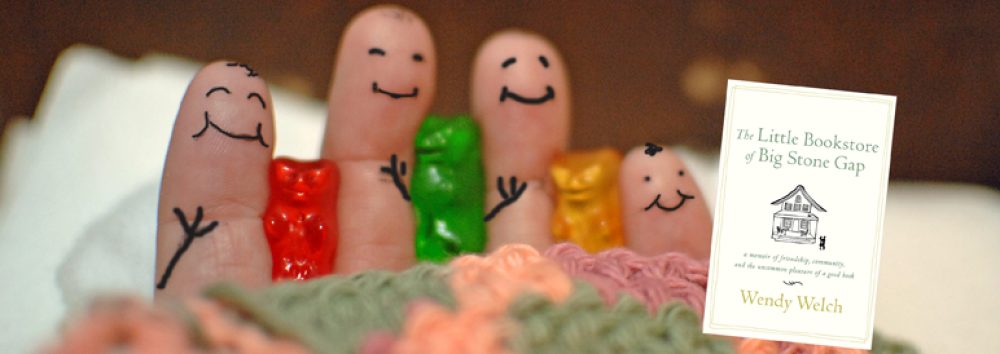
Well, my ARCs have landed. These are the advanced reader copies that publishers make to get your book into the hands of reviewers, other authors, and anyone else likely to like what you wrote–and in a position to say so to a few thousand people.
They are pretty. I LOVE the cover of The Little Bookstore of Big Stone Gap. I didn’t have a thing to do with designing it; the amazing Nichole and Laura at St. Martin’s Press sent a first draft of the drawing, and Jack and I were smitten (although we did ask David, the artist, to add a cat anyplace he fancied. His second draft became the cover.)
What’s fun is, that’s what our house-cum-bookstore looks like, right down to the chairs on the porch. And while we don’t normally dance in the front yard, we have been known to take a twirl around the front room now and again.
So these arcs with the beautiful covers have wended their way to bookshops across America, and notes are trickling in from the people reading. Just simple stuff: “enjoying it”; “love the part about the guerrilla bargainers”; “I laughed out loud over the policeman!”
Affirmation, I think that’s called. So far no one has written to say, “Who told you this was interesting, you moron?!” Which makes me happy.
But what makes me happiest is the booksellers who say “Oh, this happened to me, too!” Tribal siblings finding one another. Bookslinging is a hard way of life, but boy it’s a good one. One worth fighting (a lawsuit against the Department of Justice) for, one worth braving even the jungles of Amazon to preserve. Booksellers don’t just sell books; we know who wrote them, when, yet also why, and what happened because of their publication. We not only preserve the past, but predict the future.
We’re like nuns and monks, only not so much.
Of course it’s lovely to be told someone’s enjoying my work; everybody likes appreciation of what you’ve created, be it basket, baby, or book. And of course St. Martin’s Press sent the arcs to garner interest and comments; it’s all part of the ever-chugging marketing engine, and we need have no illusions or “playing the daft blue-eyed laddie” as they say in Scotland. But I do the happy dance when a fellow bookslinger messages on one of the myriad electronic pathways by which we can so easily find one another now, to affirm the human connections our work brings. It makes Jack and me feel like part of a big, hidden team.
We love our shop in and of itself, but knowing it’s got cousins and grandparents out there makes us sweep the steps with a little more vigor in the morning. We have a lot to live up to. Thanks, y’all!
(For anyone interested in winning a copy of The Little Bookstore, Caption Contest III closes July 20. Scroll down to July 8’s posting to see the photo and enter. It’s fun, and the existing entries are side-splittingly funny.)
 Wendy Welch: Books, Yarn, Cats, Opioids