
Christmas with the Family

Sometimes you just can’t write blogs because you can’t say anything much. Family Christmases at my parents’ house tend to happen in January because that’s when my older sister and her husband can get away from his demanding job as a high end woodwork guy. He’s the only one who knows how to run the machine that does the specialty stuff and specialty stuff is a BIG DEAL for rich people around Christmas.

We don’t mind the lopsided holiday season. I tell everyone we’re Orthodox and that’s why we usually celebrate on Jan. 6. (We’re not but it’s easier than explaining family dynamics.)

Our family Christmases put the fun in dysfunctional. My dad grew up on a poultry farm, and once he left home, he refused to eat another bird for the rest of his life. He’s 86 now and still holding to that promise. My mother grew up on a poultry farm and likes turkey and chicken, just not eggs. “I know where they come from,” she says.

So cooking for my family on Epiphany Day – ehm, sorry, Christmas – can be, in a word, silly.

Start with breakfast. My father lives for bacon. Apparently the pig farm next door to his parents’ chicken run didn’t dissuade him. So he makes bacon in the microwave while my mother scrambles eggs for him and egg beaters for herself. And don’t forget the biscuit. This sounds not too weird, but the biscuit is made in an air fryer that doubles as a toaster, and it uses infrared waves instead of the usual convection, because my dad loves gadgets. So the label of the fryer has “Pizza, toast, baked potatoes” instead of the usual bake, broil, warm kind of thing. I refer to it as bake, cattle, and roll. Which no one in the family thinks funny.

The microwave doubles as a convection oven. Yeah, they make those. I have never actually explored whether dad is making bacon using microwaves or the more conventional–sorry, convectional–kind of heat. I am afraid he will start asking me to make it. I loath bacon, even the sight of it. That stuff is gross. I accept that this makes me unAmerican.

After breakfast, we open presents. All the women in my family are addicted to thrift stores. We tend to give each other interesting things: wicker baskets stuffed with little soaps, still marked 25 cents each. Habitat for Humanity tags have the kind of glue that could solve earthquake construction problems worldwide. This year I got a Snoopy and Woodstock that sing when you push the button (Goodwill). Tracy got a sweatshirt of Scotty dogs decorating a tree (AmVets). Mom got a bag with her first name embroidered on it (Salvation Army).

Then, because it is Jan. 6, we take down the tree. The tree is small, four feet high, made of plastic. Actually, you can’t see the tree because every square plastic inch of it is covered in ornaments.

My mother lives for Christmas. 19 plastic totes, two of them alone holding angels, adorn the corner of our garage. So after the ritual breakfast and presents, they adorn the living room. It takes two grown women an entire day to dismantle the tree, the seven nativity sets, and the outside decorations, replacing each in their designated box, and each box in a Merry Tetris Christmas sort of way back into their plastic totes. I started wrapping a non-box Nativity in paper towels in the tote, and my mother said, “Those pink ones are for the other nativity. Use the brown paper towels.”

Control issues aside, my mom really does Christmas up. There’s not a room in the house unfestooned with something red, green, or sparkly. During the pandemic, out of sheer boredom and unwillingness to buy one more plastic thing from Amazon, Jack and I made her a Christmas tree out of stacked and glued cat food cans, decorated with stick stars. She still has it. It’s hideous but you know, we made it. And it’s a Christmas decoration.

The ritual Replacing of the Totes (with their carefully repackaged objects in their carefully aligned boxes) back in the corner of the garage signals the end of the season. All is calm, all is right. Until next Thanksgiving, when we will pull it all out and do it again. Because, family.
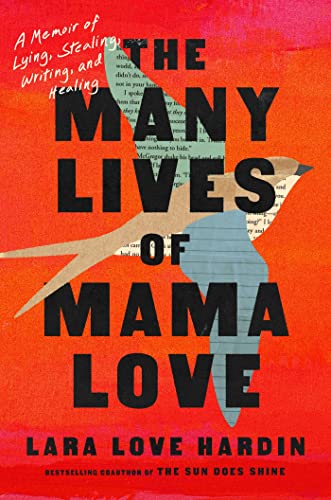
The Monday Book – The Many Lives of Mama Love: A Memoir of Lying, Stealing, Writing, and Healing by Lara Love Hardin

Guest review by Janelle Bailey, avid reader and always learning; sometimes substitute teaching, sometimes grandbabysitting, sometimes selling books

The Many Lives of Mama Love: A Memoir of Lying, Stealing, Writing, and Healing by Lara Love Hardin

The Many Lives of Mama Love: A Memoir of Lying, Stealing, Writing, and Healing by Lara Love Hardin

True story within…and confessions, as well, that had to be difficult to publicize. At least one member of our book club, which met recently to discuss this book, disliked the start of the book so much that she could not, would not read it through to the end and sent such word to our book club meeting, so troubled was she by the story of a woman who she saw as having wronged her children in this manner.

And yes, given the book’s subtitle and its chronological movement through these themes, getting through the “lying” and “stealing” portions of the book can be challenging. This is not easily an “unlikable” main character, nor a challenging or unreliable narrator. Given that this is Lara Love Hardin’s memoir, and she is telling her own story, this opening narrative had to be even tougher to write/confess/publicize, than it is to read it. And as a reader I did have similar feelings to my fellow book club member, initially, about the choices Hardin made: drug use and the ensuing horrible behaviors seemingly chosen over caring well or completely for her–their–children.

But I had to believe that since she’d also written the book and was telling her now published story, that I needed to keep reading through the “writing” and “healing” portions as well before I tried the book on the whole. Judging Hardin wholly and completely by what had to have been the most difficult part to publish and share seemed not fair. And I’d already purchased the book and selected it for book club, so I believed it worthy of the read.

Further, it is this difficult content and confession to bad parenting that make things challenging at the start. The writing, itself, and the storytelling, throughout, are of strong quality, due literary merit, even. This serves as testament to that MFA Hardin mentions early on and which she had previously earned. Additionally, I saw from the subtitle that the “writing” and “healing” portions of her memoir were yet to come.

I read the entire book in one day, traveling through the painful months and years of Lara Love Hardin’s storied life in just minutes to hours. Possibly in part because of that short duration of time and thinking spent in her space, and my reading style prompting me to live in it for the duration of my time with the book, I was better able to see through to the improved parts more quickly as well.

Hardin and her then husband were so caught up in their drug use that they had taken to stealing from others, both neighbors and strangers over time, to support their bad, bad habits. Their child together was in the worst spot, as each of them had ex-spouses with whom they shared custody for their others. Thankfully, when jail time for their crimes ensued, Hardin’s ex-husband and his wife took in Hardin’s son to be able to live with his brothers as well. That soothed some of the sharp edges of that part of the story.

From there we see inside the jail system–neither she nor her husband were sent to prison for a long haul–as they each spend months there, teaching us lots about what really goes on there and inside the walls. That also allowed us to learn how very difficult it is to ever get–let alone stay–out, once in, she and her husband not exactly on the same upward path toward recovery and quitting. Catch-22s and systematic challenges abound.

It is during this time of Hardin’s story that we not only learn of these difficulties from the inside but also discover where she gets her “Mama Love” name, using that ol’ MFA to help others write–and right–their own situations and stories among the good things she does while in and working her way out. She is most especially effective at helping incarcerated moms work toward reuniting with their children.

I need to stop telling you her–the–story, or I’ll take away the fun of all of the redeeming qualities of Hardin’s story and book, make it less meaningful for you to read and discover, experience it all yourself. That’s the point of reading a good book, right?

You may not, either, see the “Mama Love” goodness to Lara Love Hardin at her story’s start, but there’s a pretty good chance that your understanding of her and her plight may also grow into some forgiveness for her, too, for how hard she worked and for how much we can learn from her. And how much we may be able to do to help–rather than curtly judge or dismiss–someone working toward change when we meet them ourselves.

Come back next Monday for another book review!