We Happy Few, We Band of Booksellers

Sometimes the little guy does win. Or at least holds her own.

I’m not quite sure what’s happening with bookstores these days – small, independently owned bookstores, I mean; we can all see what’s happening to the giants; Amazon is closing them. But what I begin to suspect (okay, hope for and daydream about) is that we’re gaining ground.

Bookstores are magic places, but I don’t have to tell you that. The watering holes of like-minded souls, the gathering spot for the tribe, they come pretty close to sacred. And it seems to me that, like farmers markets ten years ago, small bookstores are entering a period of rejuvenation and revitalization, even as people decry their loss.  Readers have begun noticing how much more fun it is to shop with real people than online. Realization is dawning that—like breaded, fried fast food versus a slow-cooked home supper—faster and cheaper is not always better (and that the price difference might not be as high as one might think, either).

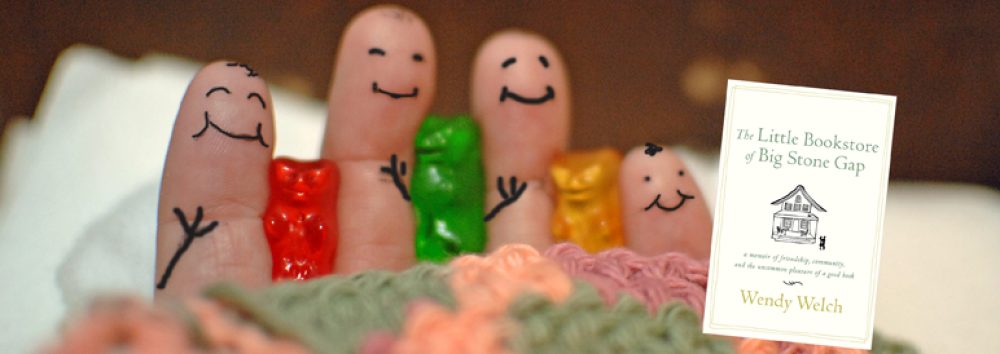
That’s why I wrote The Little Bookstore of Big Stone Gap: to celebrate this way of life that some proclaim dead or dying.  And that’s why I cried in the middle of Ann Patchett’s acceptance speech for “Most Engaging Author” at BookExpo America, when she recited the St. Crispin’s Day speech from Henry V while all these pictures of people who run bookstores flashed on the screen. Sweet people. People standing behind messy counters, in front of orderly shelves, hippies in scarves and skirts standing next to well-coiffed people in tailored suits, people who dress and think completely different from one another, arms entwined and smiling.

God love us, we are the ones who keep the barbarians from the gates. We keep a stall in the marketplace for stuff that lets people think for themselves. We take the financial risks of hand-selling things we think are good, even if they’re not commercially viable. We take trade-ins; we make staff pick shelves; we listen, listen, listen to our customers, and offer suggestions based on what they said, rather than who paid us for  a pop-up ad.

We can’t be bought, but boy-o can we sell.

I cried the whole time those pictures flashed. We are the little guys, the reeds still standing in the wind because we’re flexible, smart, and fast. What we do is so important: we help people think; we help them express themselves. And when they express themselves in particularly charming, compelling ways, we give other people a chance to hear those words that never will get made into movies.

What Ann Patchett and William Shakespeare say is true; sometimes the little guys win. Here’s tae us!

THE HUNGER GAMES WE PLAY WITH BOOKS

So on Tuesday of this past week, Amazon lost (for less than six hours) its ability to sell Kindle editions in the United States because of a technical glitch. What caused it? Those On The Inside suspect it was Harry Potter’s fault. (The fact that he’s not a real person doesn’t matter. This is cyberspace we’re talking about.)

All 7 of the Potter Books became available on March 27 (Tuesday) through Potterworld, and the uploading…. well, it wasn’t  a straw that broke the cybercamel’s back so much as a magic wand.

About a million e-reading people–what is the collective noun for e-readers anyway? An exaltation of larks, a kindle of kittens…. okay, best collective noun response gets a free book from our bookstore, postage included. Title to be negotiated, but we’ll try to accommodate your request–

{Ahem} Back to the blog. About a million e-reading people in downloading frenzy crashed the Kindle sales. The breakdown occurred at 11:55 am PDT, and by 11:58 the news was going viral. How’s THAT for market share?

One of the ironies is that the crash may have been precipitated by Potter, but it was aided by a duel of duelers. The Hunger Games had hit the theatres just a few days before, and loads of people were trying to download that trilogy as well. (Hmm, I’m getting an idea for a plot. Teens dueling to the death over … oh, wait a minute.)

So, as people attempted to download the next teen megahit the previous wunderkind thrust Voldermort’s wand into the clockworks and KABLOOEY!

(Perhaps it was revenge?)

The big question in the industry is, in the six hours before it was fixed, how much money did not change hands?

But in all honesty, what I want to know is, did anyone, in desperation to lay hands to The Hunger Games, Catching Fire, or Mockingjay, call his or her local bookstore? Because then something very good could have come out of this silver e-cloud’s lining.

Perhaps Amazon’s breakdown can be measured not in market lost but in markets gained, reopened, rediscovered. Remember walking downtown to your local bookstore? Remember bookstores? Yeah, we’re still here, and oddly enough, when we “crash” it’s called closing. As in closing down. Which bookstores do when customers don’t come in.

Why visit a bookstore instead of Amazon? Well, aside from that little crashing thing, how about fresh coffee, pleasant and witty conversation, exercise (physical AND mental), a chance to see who’s reading what, a chance to see who’s written what, a chance to find out about other authors besides Patterson, Collins and Rowling (not that they’re not great; they’re just not everybody), a chance to pet the store cat or dog, and did I mention pleasant and witty conversation?

Bookstores, greenhouses, yarn stores, hobby shops run by independent people are fun. They are sweet. They are little watering holes where like calls to like and knows it will get an answer, rather than a “we are unable to assist you; please try your call again later” or even “you are order number 765843; thank you.”

I’m not against e-readers, but I am aware of the effect they have on bricks-and-mortar bookstores, and of the tertiary effects if all our third places–those tucked-away shops and pubs and gardens that are neither home nor work, where we sit and smile and be ourselves for fifteen minutes–go away. We need them for balance. We need them to be in right relation to each other.

I don’t hate Amazon; as a first-time author, I’m forced to use it as one of the ways I sell my own book. But Amazon is one of six ways one can order a book in America. Six. Count ’em: six. (To see the list, visit the section on pre-ordering my book. You can get any book via those methods. ANY book…..)

So huzzah to Amazon for crashing, and here’s hoping that six-hour window launched at least one reader on a voyage of discovery about the battles for life that really matter.