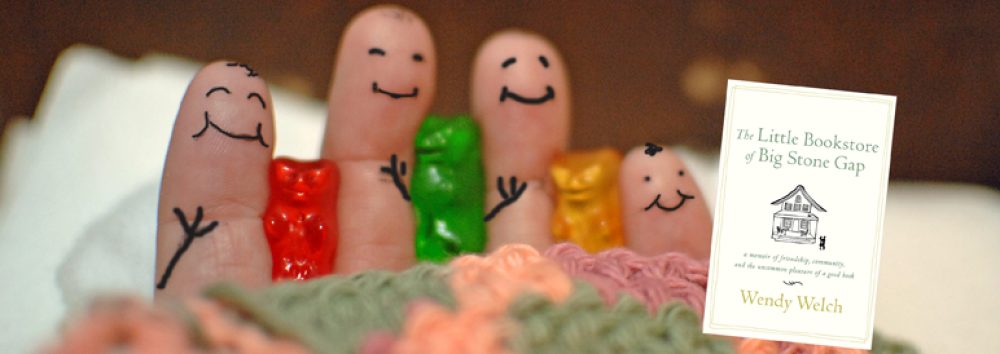
Kelly Saderholm’s guest blog about her and her daughter’s recent stint as shopsitters in the Little Bookstore –
“Oh, wow, I just LOVE it here!” The customer said as she handed me money for her purchases. “I could LIVE in a bookstore!”
“I am living here,” I said, happily, as I gave her a receipt and explained how I was shop-sitting while Wendy and Jack were away in Scotland.
“That’s really COOL,” she said. And she was right.
My daughter Rachel and I agreed to shop-sit and look after the two dogs and ever-changing number of foster cats; in exchange, we could pick out whatever books we wanted, and have the experience of tending a bookstore. For so many of us hard-core reader types, this is a secret fantasy. In the age of disappearing brick and mortar stores (of any kind but especially bookstores) I had often wondered how that fantasy would stack up against the real thing. In this case, the reality fared pretty well!
I was fortunate not to have bad days, crank customers, or disasters. The worse thing that happened was that Bert, one of the dogs, got upset by the Fourth of July firecrackers and chewed up a basement step.
The best thing? There were so many “best things” it is hard to choose. Of course the books, surrounded by books, ahhhhh. I loved chatting with customers. With a high school class reunion and the holiday weekend, people from all over were visiting family and friends. Most had either read Wendy’s book or heard about the bookstore from friends and family. It was interesting talking to people from different regions, discovering their connection to the area.
Even more interesting were the people living here. Rachel and I fell in love with the place. I realized that our temporary home was not just a used bookstore, but Big Stone Gap’s Bookstore, catering to the needs and wants of the community. In the introduction to one of my favorite books, Laural’s Kitchen, one of the authors, Carol Flinders, talks about “a sense of place.” Jack and Wendy’s shop is very much a nurturing “Place” with capital letters, where people feel a connection to each other, to the town, the region, the culture.
Speaking of cooking and food and place- Kelley’s Second Story Cafe (on the bookstore’s second floor) is another very special place, with delicious food. She kept us well-fed during our stay!
Kelley’s food nurtured our bodies, the books nurtured our minds, but a third, intangible element of the bookstore nurtured our souls. A strong sense of Quiet pervades the bookstore. That feeling was re-enforced as Rachel and I took our leave last Sunday just as the Friends Meeting started upstairs. But the whole week there was a gentle, quiet feeling throughout the place. Several customers remarked on it. All week people came in just to browse and enjoy the quiet. One guy stayed for two hours.
If one is looking for a business to make fast, easy money, a used bookstore is not it. But, if one is a bibliophile interested in a satisfying, rewarding business–not in a profit sense but in a people sense– one could do worse than to run a used bookstore.
The first Foxfire book has a chapter titled, “A Quilt is Something Human.” It makes me happy that with so many chain retail stores selling mass-produced consumer goods, Jack and Wendy’s bookstore is indeed Some Place Human.
 Wendy Welch: Books, Yarn, Cats, Opioids