
Verna’s Blanket

Jack and I hold a Society of Friends meeting (Quakers) once a month in our bookstore. The other Sundays we attend one block up the street, in a small congregation with a kind pastor, a wise church council, and a kick-butt organ-piano duo.

Last year, the church lost one of its members after a lengthy illness. Verna was married to a man who clearly adored her as much as she did him. While her ability to walk dissolved, she leaned on his arm; when it was gone, he pushed her wheelchair. We laughed and joked and talked with her as we’d done every Sunday, pretending we didn’t see. Verna was a dignified woman; always carefully dressed and coiffed, she waited in her pew ahead of everyone else once the chair was in play, so we wouldn’t see her entrance and exit.

As her motor skills slipped, she finally had to sit in the wheelchair in the aisle rather than in her pew with Bill. He moved to its outer edge. During the hymns, he would hold the book in one hand, and reach down to touch Verna’s hand or shoulder with his other. Throughout the sermon he would periodically lay his arm across the back of her chair. It looked uncomfortable.

It looked like love.

Losing weight and bundled in a thick blazer over her sweater, Verna had for the last year or so kept a fleece blanket in tasteful muted colors folded across the back of the pew she shared with Bill. When she moved into the chair, the blanket was returned at the end of each service to its accustomed spot.

Jack and I were away when Verna died, so missed the funeral. Bill was gone about a month, then came back to the pew where he’d sat for so many years with Verna. Meanwhile, her blanket, folded neatly, lay in its accustomed place across the back.

Of course we don’t need a blanket to remind us of Verna, but we like having it there. We smile and joke and touch Bill’s shoulder as we shake his hand, and invite each other over for Sunday lunches. No one in our tiny congregation ever mentions the blanket.

We don’t need to. Like Bill’s arm, like Verna’s dignity, it’s just there: quiet, unassuming, there.
 

Don’t go Riding on that Long Santa Train

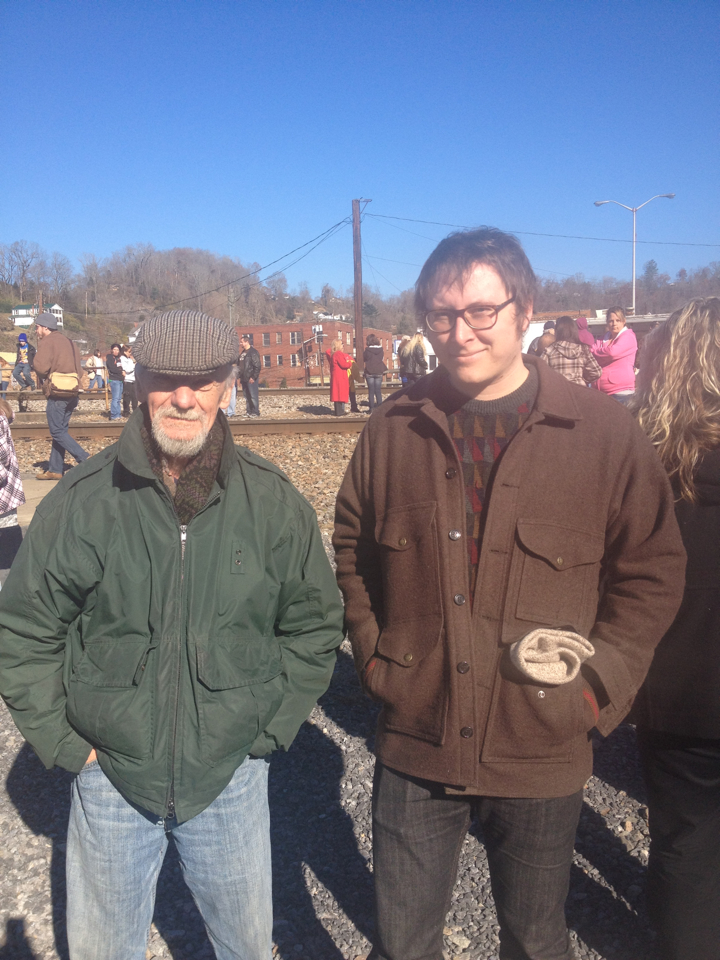
Before Andrew, our shopsitter, returned to the sophistication of the big city, Wendy’s all-girl support group (the Grammar Guerrilla Girls) decided he must experience the ultimate Appalachian tradition: The Santa Train. Since I had never seen it, I tagged along as Shelley—who drew the short straw and had to take us—trundled Andrew to one of its nearby stops, the tiny town of St. Paul.

We arrived an hour early to find the classic small-town specialties of any festivity: a car show, street food, and craft vendors. Already, people lined the track; Andrew and I goggled at the massing crowd of parents and children (many in red-and-green Christmas garb) held back with flimsy hazard tape, railroad workers patrolling with bright grins and brighter yellow uniforms.

As we had very little idea what to expect, the appearance of a juvenile clogging team in full regalia didn’t throw us off—until their teacher screamed “SHELLEY!” and grabbed our guide, introducing her through the loudspeakers as “Our Special Star Guest.” Bluegrass music then blared as feet began to fly.

Apparently, they went to school together.

A sudden electricity buzzed through the crowd, and the dancing stopped; the train was coming. Anonymous faces appeared at its windows; we later learned that it’s considered a great honor to ride the Santa Train, mostly for politicians, sponsors and country music wannabes. Invitation angling starts in February.

None of those fortunate few ever did come out to greet the locals, but as the last carriage drew level, the real celebrity emerged. The crowd surged forward, train brakes squealed, and Santa and his helpers began chucking toys, candies, wrapping paper, and clothing (mostly hats and scarves) to people who scrambled and sometimes fought over the bounty.

Children on parents’ shoulders caught soft toys mid-arc while nearby a rescue squad team had arrived, following the train. The rescue workers began flinging board games into the crowd. I glanced at Andrew; his face went white and deadpan as he watched a woman catch one side-on just inches from her face. She squealed—in delight or relief?

So, what did I make of it all?

The Santa Train is a 70 year old tradition that seems to have started as a genuine philanthropic act (you can google it) designed to give people of limited finances a leg up at Christmas. Coming as I do from a country that—like Appalachia—is often characterized as poor, unsophisticated and deserving of charity rather than investment, I found the whole thing a bit embarrassing.

Who is this train for: the people getting largesse flung at them, or those sitting inside, warm and smug at getting to ride it? And which tradition is older: giving to one’s fellow humans in a spirit of generosity, or feeling good about being better off than those poor weirdoes over the hills and far away?

And what about those lining the tracks, grinning as young’uns grabbed goods from the air—or even snatching things before kids could? While for the most part adults were protective of all the attending children, we saw some displays of poor sportsmanship.

The Santa Train reminded me of a story my academic wife tells in her guest lectures on “cultural competency” toward Appalachia:

A woman visiting family was downtown and saw some teens teasing a special needs boy their own age. One held out his palm, a nickel and dime evident.

“Which do you want, Bubba?” he asked, and Bubba replied, “The Nickel, ‘cause it’s bigger.” The boys laughed and handed it over.

The woman waited until they’d gone, then approached the victim. “Son, those boys were making fun of you. A dime is worth more than a nickel, even though it’s smaller to look at.”

The boy grinned. “Lady, I know that. But if I take the dime, they’ll stop doin’ it.”

I thought of this “joke” as Andrew and I watched adults with two and three Hefty sacks full of goods walk away, joined by children clutching their stuffed animals and mothers holding rolls of wrapping paper. All grinning.