
Firmin

My agent, Pamela, recommended a book to me awhile back: Firmin, by Sam Savage. The short version is, it’s about a rat who learns to read and lives first in a bookshop, then with a writer.

Pamela, who knows me pretty well, said she thought I’d enjoy the “post-modern ironic opening scene” of a mother rat ripping up an encyclopedia to make a word-lined nest for her infants.

This book is not unlike a rat’s nest: layers inside circles within layers. firmin

Firmin, the rat hero of this tale, grows up literate and confused; self-aware but not all that savvy, he finds out the hard way that humans assume he’s either vermin, or a cute fuzzy thing with pink toes and big eyes. (In a moment of pure speculation, I am assuming that’s how Monsieur Savage came up with his name: adorable fur, nasty critter, Fir-min.)

But deep down Firmin longs to be accepted, to be loved by the bookshop owner in whose place he squats, then appreciated as an intellectual equal by his writer, who gives him a home as his pet. The scene where Jerry (the writer) takes Firmin to see Old Yeller–or was it The Yearling?–is hysterical, but like all good humor it stems from pain, because Firmin’s been watching porn at that theatre all his life. Yet he mugs for Jerry, pretending to be frightened of the animals onscreen in a way that makes his “owner” laugh, while internally writing a scathing review of the film’s oversentimentality and other shortcomings.

This is on the one hand a complicated book, and on the other a simple one, depending on which layer one pays more attention to at any given moment. A neighborhood is being destroyed, its small shops giving way to urban planning (ironically enough, to get rid of the “vermin” among other civic-spun reasons). The bookseller who–in frustration at losing his shop– gives away his books one step ahead of the bulldozers is based on someone Sam Savage actually knew.

I don’t know that I can write–that I have written here–a review of Firmin; what I can tell you is that I loved it, and enjoyed it (two different things) and learned from it.

And I can tell you that one of the women who now works at Malaprop’s (the grandmother of Southern independent bookstores) was an intern at the publishing house where Firmin came as a submission, and that her desk was one wall over from the acquisitions editor who read it. She remembers hearing “laughing and crying and ‘Oh s^^^’s coming through the wall, as the editor read it.”

I can see why.
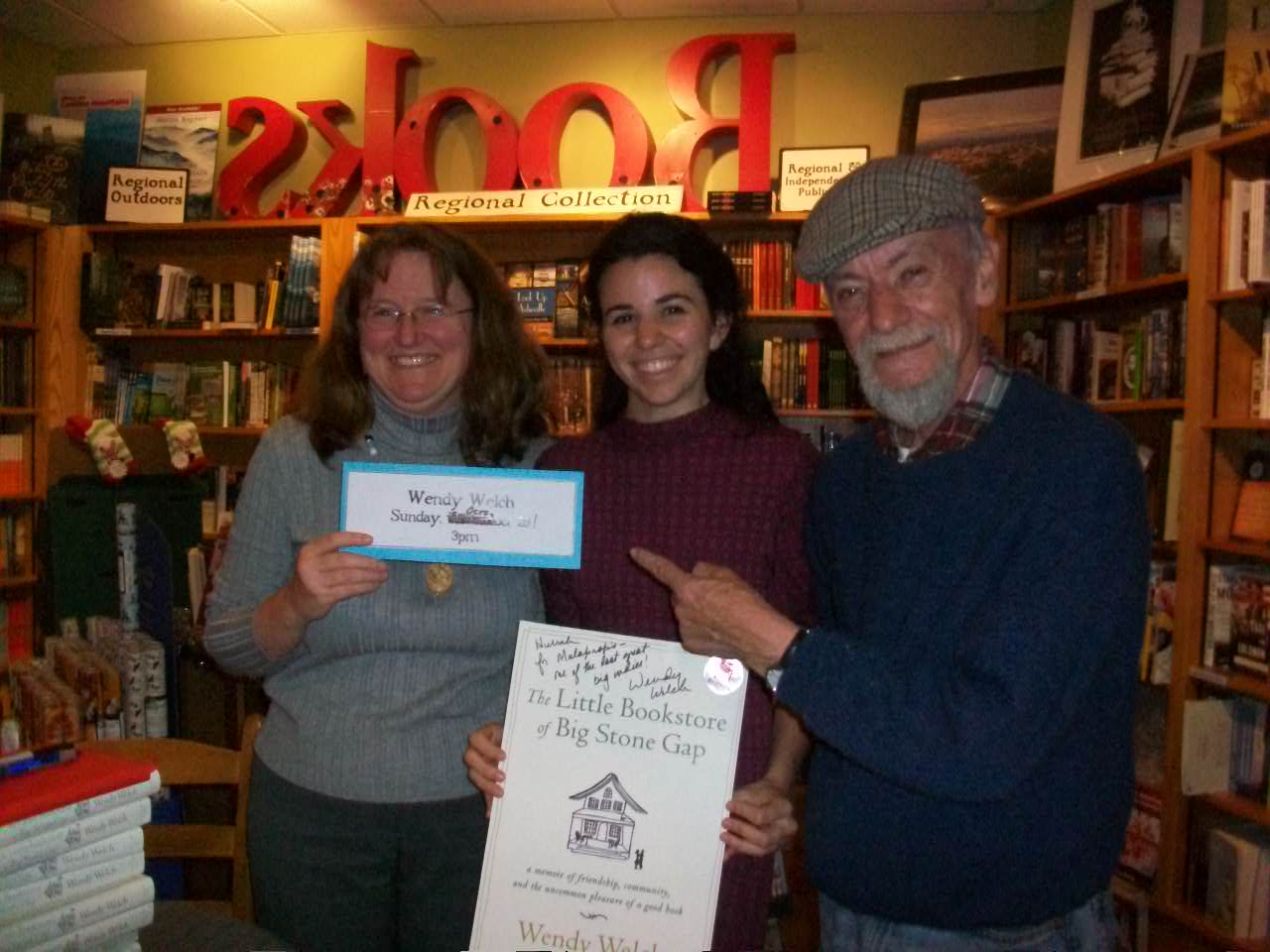
Malaprop’s Sweet Malaprop’s

One of the fun things about running around touring a book is all the great bookslingers you meet in shops you’ve not seen before: Ann at Spiral Bookcase, Ruth of Book People.

Then there are the old familiars, like Malaprop’s.

I’ve been going to Malaprop’s since college, when I discovered the South’s San Francisco in Asheville, North Carolina. For those who haven’t been, Asheville is a city full of hats, dogs and same sex couples. It’s one of the best places to eat for 400 miles. And it’s got Malaprop’s.

Thirty years old this year, Malaprop’s is one of those Dr. Who bookstores that’s bigger inside than out. It’s got a cafe that serves things with long names ending in “o” made by guys who take their work waaaay too seriously. It’s got floor-to-ceiling wooden shelves in old dark wood, and cool staff. You can buy just about any snarky magnet or bumper sticker you ever imagined.

It’s got style.

Malaprop’s was a book talk I really looked forward to giving, and it did not disappoint–not even when I arrived to find myself advertised (next to Barbara Kingsolver and Ron Rash) for NOVEMBER 28th. See the woman between Jack and me? That’s Elizabeth. She runs events at Malaprop’s. That’s why she’s grinning like that.

Elizabeth was lovely, and that one piece of card had the only errant date. Their copious mailing list, the flyers on the windows, even the one on the back of the toilet stall door, gave the correct date, and I am pleased to say we had a capacity crowd: a new author whose book debuts in February, an Atlanta businessman retiring to the mountains, two couples from the town, some bookstore lovers, and–wonder of wonders–our dear friends the Volks from Big Stone Gap! They’d decided to surprise us and make a weekend of it in Asheville.

Jack and I talked about the world we live in now, full of convenience over community, one-click shopping and easy choices whose consequences lay buried behind time and media messages. I repeated my mantra that I don’t object to Amazon wanting to be the biggest, but to their wanting to be the only. We talked about Malaprop’s online service–one click, but still part of the big picture, not its whole. And we reminded ourselves, as an audience in the Q&A afterward, that what Malaprop’s and the other independents offer is a sense of place, an anchor for the place to go and enjoy oneself on a Saturday. Take away Malaprop’s and the yarn store next door, the chocolate shop across the street, the Himalayan Imports store will lose business, and wither. Malaprop’s is big and strong. It pulls customers up the street past other enticing store windows, creating commerce: commerce that sustains the heart of a downtown community.

Convenience is nice, the assembly agreed, but it’s a commodity, not a virtue. It behooves us as American bibliophiles to remember that.

Thanks, Malaprop’s (and Elizabeth) for having me there, and for being there.