
Guest review by Janelle Bailey, avid reader and always learning; sometimes substitute teaching, sometimes grandbabysitting, sometimes selling books
Western Lane by Chetna Maroo
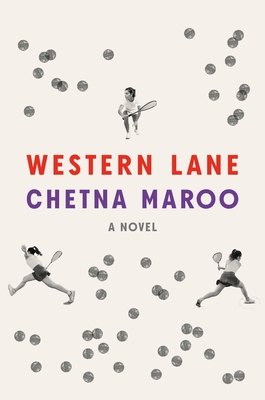
Western Lane by Chetna Maroo
I added Western Lane to my tbr and then library holds when it was shortlisted for the Booker Prize. Now that I have read a number of those that were shortlisted, I “like” this one even more, for feeling that it is a gem of a book and seeing its merit as “more” than some of the others on that list.
Western Lane is fairly short. I would accept any claims that at 150 pages it is possibly a novella, rather than a novel. But I am not certain that distinction benefits anyone, audience or author included; but a potential reader might want to know that it could be that quick of a read.
Contained within is a story of sisters, parenting, a widowed father, young–and “old”–love, and squash. It’s all set in Great Britain, and Western Lane is the name of the local club where the girls and their dad practice squash, and really the place that is closest to “safe” for most of them at this time.
Western Lane is the story of three sisters: Gopi, Khush, and Mona, ages 11, 13, and 15, respectively. It is the story of their relationships with each other and their relationships with their father, each–all involved–experiencing and processing their individual and collective grief of the fairly recent loss of the girls’ mother, also their dad’s wife.
It is actually a discussion-worthy layer of this book and possibly part of that which elevated it to the Booker Prize Shortlist, I am hopeful–that this shared loss and grief is both complexly similar among the four and also very individual to each who misses her…and individually so differently. The things they don’t or can’t say or express are very nearly as much components of the story as those they do. The book is short, but its stories are not simple or shallow. There is a lot being said in the silence, a lot taking place in the scenes when little to nothing is said. And it is up to close and generous readers to make sense of and fill in those spaces. In some ways it reads more like a movie, if that makes any sense, the reader easily sitting in the open and silent space and imagining, envisioning, what it all–especially the people–looks or feels like right then.
With this as her debut novel, author Chetna Maroo has done especially well with this short form. Perhaps her previous short story writing and publication has enhanced her preparation to operate in this space and valuably so.
I’m already eager to read whatever she writes next!
Come back next Monday for another book review!

 Wendy Welch: Books, Yarn, Cats, Opioids