
The Monday Book – On the Move: A Life by Oliver Sacks

Guest review by Janelle Bailey, avid reader and always learning; sometimes substitute teaching, sometimes grandbabysitting, sometimes selling books

On the Move: A Life by Oliver Sacks
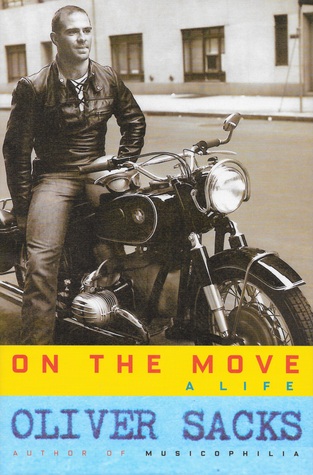
I actually listened to this one rather than reading the print version, BUT there were so many things I wanted to go back to in reference that I have since starting it purchased the printed edition as well.

Eventually I will read everything Oliver Sacks ever wrote prior to his passing, in August of 2015. By my own estimation, I am maybe 1/6 to 1/5 of the way in so far. My entry to Oliver Sacks was, like many, watching the movie Awakenings, which was based on his book by the same title. Having no idea who Oliver Sacks was and/or how he was involved with that project, I was with his very brief and relevant collection of thnext introduced to his writing via one of his short–three essays, I believe–collections called Gratitude. And ever since then I have been quite fascinated by Sacks’s stories, his brain, his storytelling–really by everything, seemingly, that makes Oliver Sacks, well…Oliver Sacks, and I wish to know and understand it all. His is a fascinating story and for so many layers of reason.

Sacks is smart and funny, thoughtful and sometimes artistically selfish, but engagedly entertaining; everything that I have read of his has given me some new perspectives on life, added interesting new layers of consideration for my own, made me think about something or some things differently from how I previously had. And if I ever do seek the attention of a psychologist, I plan to ask whether he/she/they have read Sacks. I think that’d be my standard for the smartest among them. He’s a scientist, a medical professional, a doctor–and yet he tends to people and their concerns in a patient and thoughtfully thorough way, having pondered so many situations and collected so many interesting cases over time.

In On the Move, one of his final literary projects, we read more of a memoir of Sacks’s earlier life and experiences as well as his most recent, both his initiation into romance and relationships along with fairly solid distate for it all, his coming out as a homosexual, and then as only occurred many years later, his finding true love at 77 and building a relationship with Bill Hayes. And learning about him prompted me to add his own Insomniac City to my tbr list as well.

Additionally we learn about Sacks’s relationship with his very successful and similarly smart parents, both doctors as well, and each of them passing away before him. On the Move is also about Sacks’s move from the UK to the US, and here he also explains his preference to remain an “alien” over pursuing US citizenship.

Sacks has lots to say and is a great teacher of life.

On the Move: A Life is a great read. Just like a woman who came into the bookstore recently looking for a book by Sacks and sharing why she similarly admires him, I, too, am (and already!) reading Sacks’s Musicophilia next. May I just say how much it pleased me to have someone asking for Oliver Sacks books? She explained that as a retired AP Psychology teacher, she was on a mission to read everything he had ever written. Me, too, Ms. __…me, too!

Whuffling Through the Social Sciences

IN THIS EPISODE: Shopsitter Andrew Whalen gets more than he bargained for while trying to impose a little order on life’s chaos….

Things got a little too real today when I tore apart the “-Ology” bookshelf and set out to rebuild it. This shelf contains folklore, sociology, anthropology, self-help, career advice and research best practices.

At first reorganizing was fun. In a confusing world it can be comforting to establish hierarchies and draw borders. This is the appeal of the low-stakes nerd debate. Does it matter if Kirk or Picard were the better starship captain? No, but it feels good to put things in order (this one always seemed easy to me: one survived the reign of Kodos the Executioner, has the middle name Tiberius, passed the Kobayashi Maru test, and defeated conqueror-of-all-Asia Khan Noonien Singh… the other is Picard).

But some chaos cannot be cornered, tagged and boxed. Some chaos can only be whuffled, which is the word I made up to describe the sensation and action of bottling various fogs. Or the word I thought I had made up until I typed it into a search engine and found it used to describe sniffling, gentle affection and thankless online forum moderation. If we’re going by my definition (not endorsed by the Internet) it’s a feeling that accompanies so much of what we try to set in place. And the more I stared down the “-Ology” shelf, the more I begin to think the whole world is made of whuffle.

Yes, whuffle is verb, adjective and noun. It’s very versatile.

Before the “-Ology” shelf this uncertainty seemed very abstract to me. It came up primarily when considering genre. Is it fantasy just because there are swords? Is it sci-fi just because there are spaceships? Read Gene Wolfe’s The Book of the New Sun and get back to me. Welcome back. See what I mean? And that’s before we get into odd-balls like Gabriel Garcia Márquez, Thomas Pynchon, and Margaret Atwood. No wonder people just gave up and invented the term speculative fiction.

The “-Ology” shelf was supposed to be different. It represents entirely separate realms of human knowledge! It’s like a UN of social sciences, each field a tiny nation-state with its own territories and agendas.

But my distinct borders kept getting knocked down. What to do with Typetalk, which purports to be a study of the Myers-Brigg Type Indicator, but has self-help cover language promising to aid in determining how you “live, love and work”? Things only blurred more from there. When is a study on families anthropology and when is it sociology? Are Coping with Difficult People and Coping with Difficult Bosses really so different that they should be three shelves apart, one in sociology, the other in career guidance? ARGH.

So I started fresh, with a new theory. I could arrange the shelf like a continuity. There was a spectrum at play, beginning with psychology: the individual opening up onto the family, expanding into the society, then reaching out to other societies and forms of governance before finally drilling back down into the individual stories each society treasures. Brain to Folklore, with all of human experience in between. Made total sense for like two seconds. But things just got worse. And by the end I had almost convinced myself that Life-Span Developmental Psychology and Normative Life Crises was interchangeable with Folklore in the English and Scottish Ballads.

I look at the shelf now and see nothing but whuffle. No matter how hard we try (I’m looking at you, Dewey, with all your decimals) nothing exists entirely separate and apart. Categories are cool, but they are never definite. All things interlock and nothing is simple. But as maddening and confusing as that can get for the bookshelf organizer, it probably makes for a more interesting world.