
THE DAY AFTER

So the blog was quiet this week because it was the Final Push. St. Martin’s Press wanted the manuscript “as close to finished as possible” by the Friday just past. My friend Cami Ostman (author of the running memoir Second Wind) comes out from Seattle every year for a writing retreat, and this visit coincided with the big editing job.

Just so we’re clear, this isn’t the last time I’ll see the ms. before it’s published, just the last time any big edits can be done. From here on out, it’s tweaking, typos and punctuation debates. The galleys will arrive soon.

Knowing it was the last time to make anything creative in a big way,  Cami and I disappeared to my cabin in the woods (it’s where I lived while in graduate school, and I managed to buy it once I graduated) and wrote our little asses off, our hearts out, and our fingers to numb stumps. (Insert additional cliches here.) Cami, my friend since high school, was working on a novel, and very kindly told me, “Stop me at any point you need a reader.” I wrote two additional chapters and edited one that was a dog’s breakfast, plus read the entire work through again for flow, continuity, timeline, and–yes–the dreaded Narrative Arc.

It’s funny to read something for the last time before you can’t change it. I’ve enjoyed every minute of the editing process–well, okay, except for that horrible week with chapter five that my friends had to basically haul me out of. (Thanks, Elissa, Pamela, Nichole, Jodi, Cami, Kathy, Heather and anyone else I am momentarily forgetting.) I’m not the kind of writer who gets writer’s block so much as writer’s box.

In my attempt to explain everything clearly but in a pithy way and without pissing anyone off, I create walls of words that climb ever higher; ignoring every writer’s good advice about brevity and simplicity, I keep trundling down the canyon until I reach the death-trap end, have to admit the whole thing is a wash, and call in the ‘dozers to tear down the walls and dig me out. I wind up ripping the whole thing out. It wastes time in terms of actual production, but even those blind canyons are kind of fun–and useful–in the writing process.

If you have time.

But that’s what we no longer had, that week in the cabin. Instead, a deadline loomed. A dead line. A marker in the chronological pattern after which “this” could no longer be “that.” What was written would stay written. No more “I could just revamp Chapter 12 a little…”

And for the first time in my writing life, I panicked. After this, nothing could change! After this, it HAD to be perfect! After this, the sky would turn green and the grass would grow purple and fish would carry hand guns ….

Not. After this, life would go on as normal. I would need to do the dishes and catch up on the week of work waiting at my day job while I was on “holiday.” After this, friends would call and we would go out to eat, or keep each other company doing household chores.

Life doesn’t change that much, the day after “this” becomes “that” permanently. As Anne Lamott says (paraphrased here) whatever you’re expecting after you write what you meant to say and turn it in, don’t. Just move on.

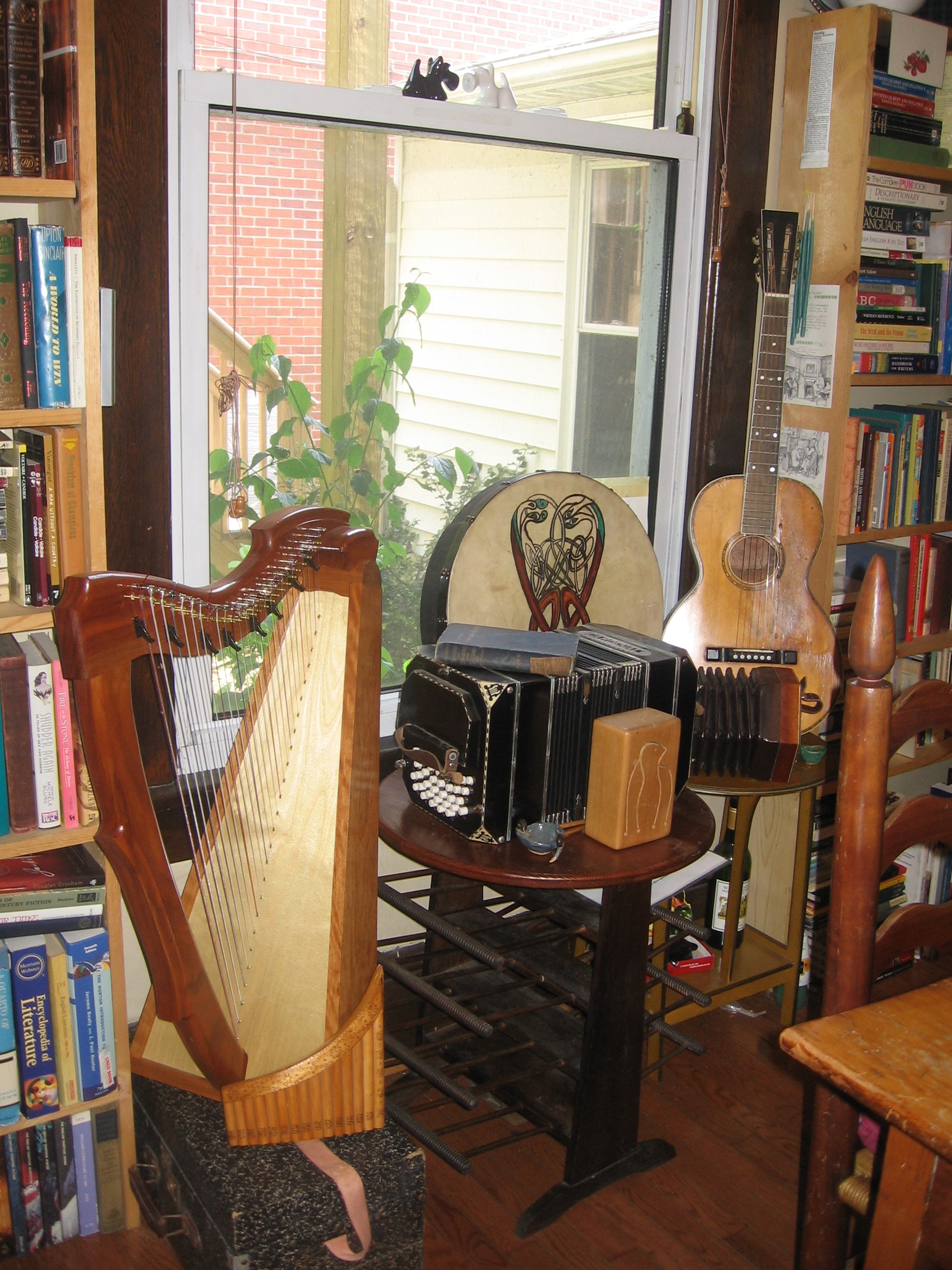
We write what we mean to say, as well as we can, with sincerity and adjectives and perhaps a sense of humor, and then we go on living. I’ve got a bookstore to run, and a bunch of friends to hang with, and some laundry that is long overdue. My husband is still a sweetheart and our upstairs kitchen is still overrun with foster kittens waiting to be adopted. I can go back to practicing my harp, which I’ve missed.

79,116 words and two loads of towels later, life still looks sweet.

THIS STORY IS NOT GOING IN THE BOOK!!!

My husband became an American citizen this past week, a moment of pride and pleasure for us both–and for the 12 friends who attended the ceremony with us. Wearing his kilt and a broad smile, my beloved took the oath, renounced all foreign potentates, and became a vote-wielding US of A-er.

Meanwhile, my editor and I are racing toward the finish line of delivering my manuscript on time. And in trying to get that narrative to arc its back without hissing, we took out a couple of stories. One of them is so gosh-darn funny AND so timely to Jack’s new status, that we thought it would make a good blog post instead.

Here is the (typical small town) story of “Flaggate,” which will not be appearing anywhere else this season. I should add that Jack and I AND the attendees of the ceremony find this is a sweet and funny story, not a chance to make fun of anyone or anything. Basking as we are in the glow of our newest American, we love to retell this tale. Enjoy!

FLAGGATE

My husband is a laid-back, mellow person, embodying the gentle-soul-in-a-baggy-sweater image of the wise old bookseller. It takes a lot to rile him. So when our town exploded over the simple issue of whether or not to have a farmers market, Jack watched the whole thing with silent bemusement.

Such shenanigans for so little! Henry Kissenger correctly suggested that people fight harder when the stakes are smaller. The town factions pulling at each other (about  local farmers selling healthy foods to people who wanted to buy them) resembled nothing so much as parents of kindergarteners arguing over which team would bat first in the Little League Goodwill Games.

One fine day Jack closed the newspaper on an article ridiculing the “Market Master” plan, and said he was going to the town council to voice his support, along with others in favor of the idea. And off he went.

The town council had never met anybody like Jack—literally. As with many small towns, Big Stone tends to be a place where those who are different—like, say, the man who lives with his mother past the age of 30 and vacations annually at Fire Island—fly below the radar until the glorious day someone says, “Yeah, they’re weird, but they’re ours.”

Visitors to Big Stone still have the local Jewish family pointed out to them. A minister caught in a compromising position prompted folk to drive by his house throwing underwear onto his lawn until he left town. (Likely the poo-pants flingers later rounded up their offerings and donated them to the poor, being caring Christian souls.) Europeans and Asians use our bookshop as an informal support group, a place to talk about that “y’all ain’t from here” wall that foreigners—a group encompassing those from India to Kentucky—each hit at some point.

So as Jack spoke his support for the market, the council listened with quizzical looks on their faces. He repeated his words, slower this time, trying to flatten his Scottish accent for untuned ears. Other Friends of the Market members echoed him with fewer glottal stops. It worked; the town agreed to relinquish a centrally-located parking lot as a location, and offered a small stipend for getting the market going. No mess, no fuss, no bother.

Except, in the aftermath, a campaign started to undo all that. Jack,  who by then had joined the market’s Board of Directors, received a letter from a local merchant, calling him an illegal alien and swearing the writer “would see your green card revoked and you in Hell, Mr. Big Shot Irish Man.”

Back Jack had to go as the market board’s president, and re-request the council’s assistance, since the decision had become “disputed.” If he had any doubts as to how deep feelings ran, they ended when Garth (a benevolent council member) pulled him aside just before the meeting and asked, “Jack, would you mind putting your hand over your heart during the Pledge of Allegiance?”

Jack became momentarily befuddled. In our tiny town, Quakers (which Jack and I are) were just weird enough to sometimes be confused with religious groups who object to pledging the flag. But his council friend clarified. “Two of the other councilors said it was ‘disrespectful’ of you as a foreigner to stand with your hands at your side during Pledge.”

Ours is a patriotic town.

Jack put his hand over his heart during the Pledge of Allegiance, and two of the council members looked over their shoulders at my husband–twice. Standing next to him, I couldn’t help myself. My own hand had up to this point maintained a correctly American position—although it probably should have been over my mouth. The second time they looked back, I took my hand from my heart to twirl my fingers in a wave, smiling brightly.

Neither of them looked again.

Jack laughed it off, but I seethed for days. Big-hearted and easy-going, my husband had never disrespected anyone in his life; he just wanted to help build something good for the town, namely this farmers market so many people had asked for. So I researched what foreigners were supposed to do during the American Pledge of Allegiance, and brought Jack my findings.

“According to the U.S. Code of Conduct, non-Americans should stand quietly with their hands at their sides, facing the flag.”

Jack smiled and took the printout from my hands. “Let it go, Wendy.”

I tried, I really did, but using patriotism as a shield for flat out being meaner than a rattlesnake in the rain irked. Of course, I had underestimated my husband—as had the councilors. Without telling me, he went to their meeting a third time, to thank them for finally agreeing to support the market.

And apologized.

Standing in front of the chamber’s long curved table on its raised dais, Jack said, “It appears that I behaved disrespectfully to you on a previous visit. I am not from this country, and when you pledged allegiance, your flag’s Code of Conduct states that I should have stood facing the flag with my hands at my side, silent and respectful. Instead, I put my hand over my heart. I most sincerely apologize for this, and hope that no one has taken offense. Please be assured I will properly show respect at all future salutes in the way your United States Code of Conduct stipulates.”

One of the councilors who had been checking Jack’s hand position couldn’t find anywhere to put his eyes; his partner reshuffled papers with deep concentration.  The rest of the panel looked either baffled or amused. Garth hid a grin behind his coffee mug. The mayor, a cheerful woman who would have liked people to believe our region less bigoted than circumstances sometimes suggested, let her smile reach her eyes as she thanked Jack for coming, culminating with, “We are lucky to have the diversity you add to our town.”

A murmur of assent rippled around the assembly, while councilor number two still couldn’t get his papers in order.

Keith Fowlkes, one of my friends from the nearby college, often quotes his favorite Chinese proverb: “Ma ma, hoo hoo.” This translates idiomatically two ways: put simply, it is a nice expression for “mediocre at best,” but its more complex etymology suggests that, in life, some days one is the horse, some days the tiger.

I think my husband must be the gentlest tiger in the world.