
12:01 The Day After

Book launches are funny things – and fun ones. You spend a year going over with a fine tooth comb every nuance and gerund of what you’ve written–first with your editor, then with the copy editors, then with the publicity team–and then there’s this short period of silence, followed by more bleedin’ marketing work than you ever knew could exist.

Amid the flurry of learning the secrets of social media (that there aren’t any) and the hoopla of “getting your web presence increased” you find that the book drops back to a distant reason for why all this is happening, but not the core of what you’re working on.

And then, this date that’s been on your calendar for weeks and months, or even a year, is tomorrow, and you haven’t got party hats or a plan. But you just move through the day, and then it’s midnight and your book goes off into the world. (Since we own a bookstore, and since some friends asked us to, we stayed up until 12:30 so we could sell books at midnight. I don’t recommend this as a lifestyle, but it sure was fun as a one-off brief party!)

And then the eye of the storm passes directly overhead…. all through the weeks leading up to publication, there are bloggers and GoodReads reviewers and other worker bees in the publishing world, getting your book presence in the big world. But once anyone can buy it, who does? How?

Sitting in that eye, the day after publication, it’s good to know a couple of things: that you meant what you said, and that what you said means something to others; and that you are part of a vast eternal library of all people, in all time, who have put out words that can be read by other people.

That first one makes you happy, especially when you see reviews from readers who have identified with, understood, even challenged what you said in a way that you think opens a healthy discussion. I feel like I’ve contributed something nice to the bookselling world. That second one keeps you balanced, and reminds you of your place in the grand scheme. Like the machine Douglas Adams invented that tells you your importance to the proper functioning of the universe (.01%) all you have to do, the day after your book gets published, is walk into a bookstore and look around.

As Masha Hamilton said in The Camel Bookmobile, “You are a part of this dance. You are not its center.” That’s a good thing to remember, because to your friends and family, you are the center of something, and it’s all too easy to mistake your small world for the big one. That would hurt. And be unwise.
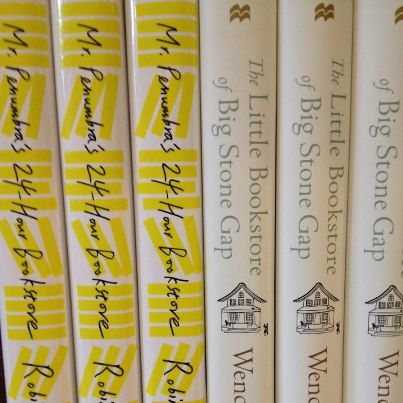
So, my little book about our little bookstore is even now, knapsack over one shoulder, wending its way through the twists and turns of the Great Wide World’s path. It is navigating the mountains of China (got a foreign language contract in Mandarin!). And it is, I think, whistling a cheerful tune. Because it says what I meant, and it says things that mean something to other people.

Good.

How to Be in a New Place

As Jack and I cope with book launch day, Andrew-the-shopsitter guest blogs about living in new places and making new friends. Take it away, Andrew!

How do I write about Big Stone Gap? I think there’s a temptation to cram it into an existing small-town narrative. Something about nostalgia for times past and simple living:

The local diner feels like a time machine, a place where people still get together and talk over a cup of coffee…

I didn’t expect to find ___________ (iPads, greek yogurt, movie snobs, a good slice of pizza) once my Greyhound pulled away from the island of Manhattan.

Seeing photos of bluegrass and country stars stretching back 40 years on the wall of Maggard Sound is a reminder of the rich cultural traditions of the region…

Community still means something in Big Stone Gap…

None of these things is completely untrue. The Mutual Pharmacy and Diner actually is a great place where people know each other. And yes, my bloodstream has been enriched by their grits and two types of gravy (I know the brown is made on-site, but I still prefer the white). People have been friendly and welcoming, demonstrating the hospitality and the occasional Yank-ribbing I had expected.

But to take any of those stories and make it what Big Stone Gap is about, now that’s just unfair. But I think there is a real lesson to be taken from being dropped into a new place, whether Big Stone Gap or Atlanta. How we experience the identity of a place isn’t so much about a cliche you can drop on an entire populace, but about how we as individuals engage with those around us.

When I moved to Seattle after college I found myself learning the city: its streets, restaurants, bars, and parks. But there were some ways in which I would never know the city like my native roommates. They were of the place and had absorbed a culture that would never be totally mine. Still, there were times when I felt like I had the edge, whether knowing the restaurants in the International District, or the best bars downtown.

My point is not just that I’m a freakin’ genius who is better at living than others (maybe I’ll save that argument for a later post). My un-genius became clear to me when I went back to Columbus, Ohio, where I grew up and lived for 19 years. I’d borrow my Dad’s car and get lost for hours trying to find a sandwich shop I ate at every day in high school. Or I’d go to get Chinese food and realize that the place had closed and I didn’t know where else was good. Or friends who lived in Columbus would tell me to meet them in a certain district (I’m looking at you Victorian Village), and I had never even heard of it.

I never had to engage with Columbus. And while my heart knows it and is of it, I never gave the city the thought it probably deserved, because it was never forced on me. In Seattle (and later New York) every step down an unfamiliar street, every trip on the bus, was entirely new. My engagement with the city had to be a conscious one, or else I’d probably still be wandering around the Central District, lost and hungry.

When I’m walking around Big Stone Gap I am entirely out of my element. So I’m back to needing conscious, constant engagement. Every step, every opportunity to meet someone new or try something different deserves my full attention. Amazing people (Gappers? Stoners? Biggers? Gappees? Gappinites? Gapperois?) have been open to sharing a bit of themselves, but it’s ultimately on us as individuals to grab at any chance we’re given to learn more about our surroundings.

And I think that’s a point worth making. Perhaps with some effort we can even try and see our own communities in the same light. Look at it like an outsider and grab at those chance encounters and friendly offers that we so often pass up. Could I hang out in a diner in Brooklyn and jaw with regulars? Or catch a Celtic concert and swap stories with the musicians? Or drop by the work of someone I’ve only just met, just to see how cool their job is? Probably, yeah. But I wouldn’t. And I didn’t. But I have in Big Stone Gap.