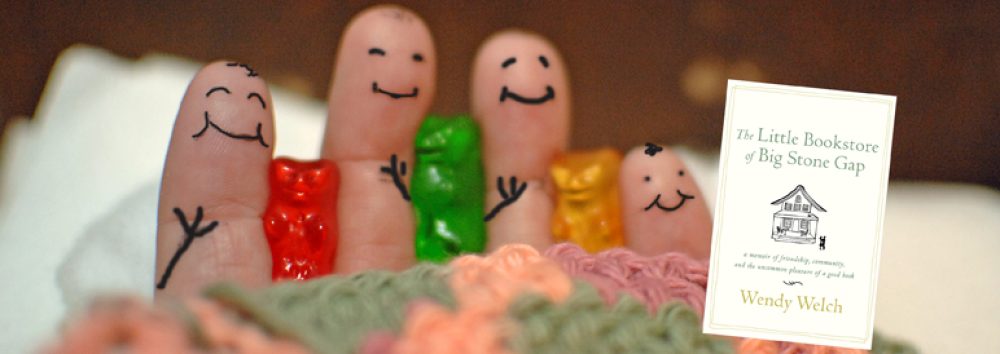
Last year, my husband Jack and I decided to take a vacation in celebration of two things: 1) five years of keeping Tales of the Lonesome Pine Used Books open despite e-readers, a tanking economy, and online sellers; and 2) that an agent had agreed to represent my book about our bookstore–a woman whose kind heart, spot-on instincts and amazing brain got my book proposal shored up and out the door in three short months.
The day after the proposal ambled off to make its way in the world, we did what any small-town small-business owners would do: hopped on the Internet to hunt 1/2-price vacation deals. (We had a lot to celebrate, but not much to do it with.)
Chicago proved affordable; off we flew for a week of forgetting we were poor. Our last day there, I awoke to an email from Agent Pamela; two publishing houses wanted to talk. On holiday herself, Pamela nevertheless called me, her voice exuberant as she explained, “We have sold this book, Wendy; it’s just a question of to whom.”
Jack and I did the happy dance around our hotel room, pelting each other with pillows. We half-waltzed, half-floated down the stairs and around the corner to our usual breakfast nook–
–where the newspaper on the table lay open to a story that all remaining Borders Bookstores were closing.
Human hearts can sing with joy even as they crack open.
“Bookstores are doomed” blared the op-ed, while the news story gave facts and figures. Jack and I both cried while reading; here we were, on vacation from our solvent-enough shop, giddy with happiness that a book about our bookstore would be published, and one of the big guys was going down for the last time. Drowning, not waving.
Jack looked at me. “We passed a Borders yesterday, near the hotel.” Off we went, coffees unfinished.
Some of the staff were dismantling computers, pulling wires out of walls. One was crying. I heard customers asking if the books were half-off now.
I don’t know that I can convey this well, but in that moment “my book” became a book honoring we happy few, we band of booksellers who make sure people have access to not just the best-sellers, but the quiet wonders as well.
What we booksellers do is important, more than nostalgia, more than casual access to retail. Social Justice, All God’s Critters Got a Voice in the Choir, Equality, Education: take your pick. We represent an open market of free ideas, with value tied to meaning more than money. We have to be in our children’s future, or more will be lost than the feel and smell of pages. So much will be lost that the next generation won’t be able to count it. Worse, they won’t even be able to name it.
So Jack and I came home from Chicago with a book deal, and 20 books we’d bought at Borders–plus Unabridged, Myopic and After-Words. And we came home with an unabashed–and unquenchable–fire in our bellies, determined to be lifelong advocates for books and the people who sell them. That impractical, improbable trip to Chicago has been on my mind lately, as Little Bookstore prepares to launch Oct. 2
Because bookstores are more than important; they are irreplaceable.

