
A Walled Garden

19206160_1634797773197947_1339798747_nIn the city, space is a commodity. I’ve always thought of cities as incongruous lonely spaces – so many people, so little humanity interacting.

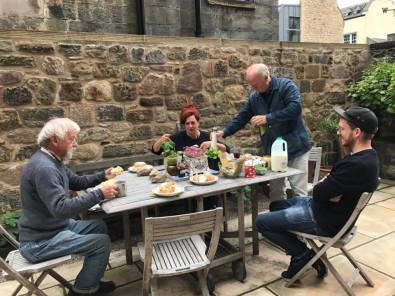
But we are staying with friends in downtown Edinburgh, not a mile off Princes Street (downtown) and they have a walled garden…..

I love walled gardens. Your own little bit of marked off territory for just sitting, thinking, being quiet and contemplative with a book and a cup of tea, or loud and boisterous with instruments and a bottle of wine and a handful of mates.

In the middle of the city, you can find the greenery and the fountains and the people who actually live in the cities, whose lives are rooted like the gardens they plant in their little secret places.

Perhaps my fondness for gardens stems back to the day after Jack’s mum died, and I was away from home in Ayrshire, in Wigtown, Scotland’s book city, and had nowhere to go to be by myself and have a good cry. And I spilled my guts to say as much to one of the bookshop owners, at Ceridwin’s Cauldron, and she took me back to her garden and brought me tea and told me to stay as long as I wanted. I spent an hour back there composing myself and being nothing but alone. Ever since then, walled gardens have been a special space.

The garden here at Barbara and Oliver’s has been a jolly place, shared for music and reminiscences and politics and the mystery of the noise coming from somewhere nearby. (Jack cracked that; it was a two-note sound not unlike the CLOSE ENCOUNTERS alien five-note theme, and he found the sewer pipe in the apartment next door was letting off gas, one note opening, the other closing. A farting building, in essence.)

Walled gardens are lovely, and every city has such little tucked-away spaces. Explore them when you can, with friends when you can. They are the heartbeat of humanity.
Who knows where the time goes –

Once again Jack misses his deadline and the Wednesday guest post appears on Thursday –

This is the title of a great song by Sandy Denny, who died far too young after falling down stairs once too often.

I find myself humming it over and over, here in Edinburgh once again, at the age of 75, after not falling down stairs very much at all—or at least not hurting myself when I did.

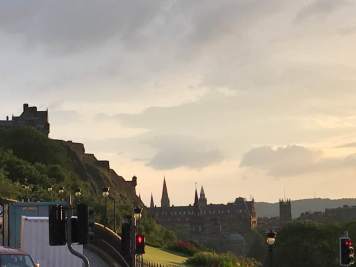
Edinburgh gives me a funny feeling, one I imagine must be felt by anyone of advancing years who experiences a less and less familiar place over a lifetime.

edinburgh

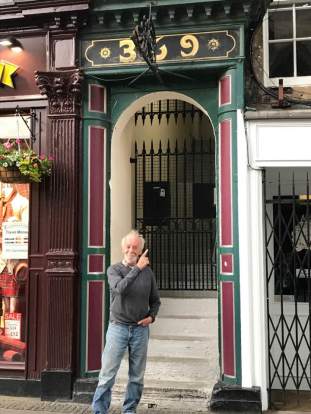
I first came here as a teenager to attend a jazz club on Tuesday nights–a 30-minute train journey on a pal’s “borrowed” student pass. It was glamorous and hippy. Outside of the August arts festival the place was mostly gloomy back in the Fifties, and if you missed the last train back you were stuck. Later I could borrow my dad’s car and the road bridge over the Forth opened – much more convenient and by then the folk scene had started. Gloom moved from buildings to music, one might say.

howff

The entrance to the jazz club is still the same (later the Howff folk-club)

The weird mix of nostalgia and alienation are exacerbated because Wendy and I are staying with my old singing partner of that folk scene. Barbara Dickson and I are both originally from Dunfermline, on the other side of the river Forth. We traveled that road to the big city morning, noon, and night to do gigs of every description, and every time I cross it, I remember something else from those fun, silly, earnest times.

And yet, as I return each year now leading a Scottish tour, the place seems more and more alien. The traffic is terrible, the good shops have gone, ghost tours and pub crawls advertised everywhere, every tiny corner has been turned into yet another marketing opportunity. Not that I can complain about marketing leading a tour, but a part of me longs to show Americans the way it was when it was a proud city bent on being rather than selling itself.

For all the tartan tat, Edinburgh manages to retain a certain grandeur – I’m really not sure how it does it. The 16th Century John Knox’s house in the old High Street is surrounded by awful opportunistic chain outlets – ‘kilt outfits for 100 pounds’ etc. (I wouldn’t advise buying one, or washing it if you do). That ancient house seems to just draw in its skirts and shrug them off, like many other historic buildings in the area.

Maybe we’re all destined to become curmudgeons as we age, lauding a golden past that never was. Or perhaps we all understand that commerce is driving the world now, not history, culture, tradition. Not that those ever did. If people remembered history we wouldn’t keep circling in the same paths.

So despite my curmudgeonly misgivings, Edinburgh retains a dignity and an allure beneath the shouts of tour leaders and vendors. There is more to Scotland than buying a plush Nessie in the High Street. Always has been, always will be.