
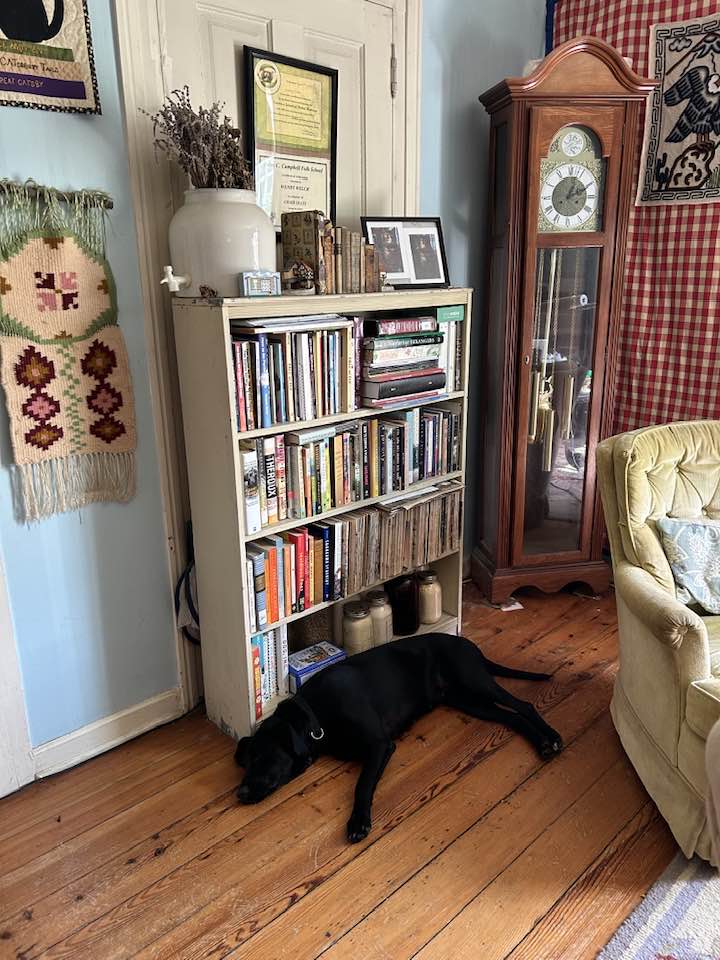
Jack and I went to the shelter to adopt a dog. We walked into the cages, and first on the right was a medium black lab mix. She was not jumping, unlike the blue heeler next to her and the big boxer across the aisle. The one marked “Good with cats.”
Our life required a good-with-cats dog. We are a feeding station for a trap-neuter-release team working on a colony in our neighborhood. Our two house cats have a catio, but outside our back and side yards are little kitty highways with rest stops and diners.
Jack fell in love with the black lab stray, brought in with another dog already adopted. The pair had been running down a groundhog and eating it, and they were covered in ticks and fleas to the point that our girl’s neck was raw with removal and treatment.
We took her for a walk. We walked her around the cat shelter area, including letting her sniff a kitten in the arms of another volunteer. She licked the kitten. My misgivings went away and Jack smiled. He was deeply in love.
So we put in the adoption papers. Under “any reason you would return the dog” we checked “aggressed or harmed another pet or human at our house,” after a bit of discussion with the two people at the shelter on whether this would slow adopting.
On Monday we waited to hear. Tuesday morning, we drove to the shelter and found our application had disappeared. But the lady working there remembered us. The shelter director had said since we checked that box, he didn’t want to adopt to us.
Well, okay, but….. the lady at the shelter said she was willing to call our references. I dialed both and handed the phone to her, and she gave me something between a bemused and baleful look. She had meant, “I will call them and let you know” but we wanted to take the dog home.
After talking to the references, the shelter worker said, “I’m gonna go with my gut and trust you. Obviously we don’t want you to bring her back.”
Home we went with the dog. In the yard, she moved so fast chasing a cat walking by that she slid out of her collar and leash.
Okay then….. a prey drive is activated by running. We recalculated a few ways to keep our kitty friends safe and made the adjustments. A height extension to the fence—which she jumped the first day. Keeping her on a leash in the house until our cats were accustomed to her, which worked. Keeping her on a leash in the yard until we were sure no cats or chickens were loose in it; we keep our chickens in a pen, but the neighborhood has two ferals who fly in occasionally. Checking the yard worked until Iona jumped up, ricocheted off a shed wall, and knocked a feral chicken down from her roost in a tree some eight feet up.
When I went in the house, Jack was distraught. “We can’t do this.”
The reckoning followed. Jack wanted to blame himself for choosing her. I wanted to delicately yet firmly factor in that Jack is 82. Our beloved previous dog, Bruce, a docile and adorable 70-pound hunk of “I live to please you” in a pit bull’s body, had pulled him over walking because a squirrel made Bruce lose his mind for a second. “Heel” kicked in because we had worked with him, but Jack came home muddy and annoyed, and once, bleeding.
At 50 pounds of livewire, Iona was going to pull Jack over multiple times before we could get her trained. And the training would have to be done by both of us, every day, for about a year. I have what could be described as a demanding job, involving a fair bit of travel. Also Iona was still in the puppy energy phase, yet old enough to have some habits, the worst of both training worlds. Kill to eat. Chase what runs. Jump on the humans and grab their wrists in her mouth to greet them—and she hadn’t learned to regulate bite strength yet.
None of it was her fault. The situation was our fault. Accustomed to having ample resources to take care of dogs (five-year-old Bruce required surgery when he came to us) we never considered that the resources of time, youth, and strength would be most important in training a younger dog.
We should have selected the six-year-old boxer marked as good with cats at the shelter. But we took Iona, confident in our abilities, not realizing that they had dissipated over the last six years as Bruce aged and left us, placid, docile, and cosseted.
So we had to face the reckoning: take Iona back to the shelter and say “you trusted us and you were wrong.” With the additional difficulty of Iona having killed a chicken hanging over her head. We would mark “not good with livestock, will chase cats” and Iona would die in the overcrowded shelter.
Nope.
Plan B: get online and admit failure and ask for help and accept that we would be yelled at for what we already knew was our mistake. We did Plan B.
And got the sweetest surprise of our lives.
Jack and I have rescued cats for about 15 years. All our dogs since our marriage have been rescues, in Scotland and in the States. So when we put our “we need to rehome Iona” message up, people inside rescues began sharing it. And saying things like “these people are smart and kind and wouldn’t rehome this dog unless they had to.” “These are two of the nicest people ever and they recognize the lab energy of this dog will not fit their homestead.” Etc.
We got 4x-removed shares from friends who shared on our behalf. And people were so kind. They identified the problem: these naïve well-meaning people got a lab. They can’t deal with a lab. They are committed to the lab getting a good home this time. They won’t take the lab back to the shelter.
And we got a text message from Barbara, musician and manager with the band IONA. (So maybe she felt a vested interest.) About a decade before, IONA had been featured at the Celtic Festival Jack and I organized in Big Stone Gap, where we ran a bookstore. At the after-party in our shop, their bass player Chuck adopted one of our kittens. He watched the dominant bully cat cuff the little orange butterball off a perch twice, and admired his pluck. Then the kitten walked across a sea of legs to sit on Chuck’s shoe. He had been selected.
The other band members rearranged their instruments and the tubby orange kitten (now named Dylan) went home with the band. Chuck and his wife Brenda (who had been consulted by phone during the afterparty) loved Dylan for years, until Chuck passed from cancer. Brenda continues to love Dylan.
And was prepared to love Iona, we were told by Barbara, and given Brenda’s contact details. A phone call later, we were convinced her fenced yard, loving heart, experience with dog training, and understanding of Iona’s loving heart and lab energy had landed our girl on her four feet.
We arranged for Brenda to come meet the dog, and if all went well, take her home. Enter the shelter. The woman who had believed in us told us we had to bring the dog back to the shelter. We understood: the pattern had a bad optic, someone adopting and almost immediately rehoming a dog. Not a good look.

But she was again gracious enough to listen to our explanation, to understand that we wanted to keep the dog out of the shelter as it was now crowded, and we wanted Iona to never have another chance to endanger her own life by going after livestock. She was going to be a pampered pet in a suburb with a high fence around her very own backyard, free from other animals. Dylan was a couch potato house cat and in no danger from her. It was, in a word, perfect.
For the second time, the shelter lady showed her commitment to animal welfare with flexibility.
Iona has a spay appointment and a thousand chew toys, and a mom who works from home. Brenda has joy in her voice as she describes adopting a dog named Iona from the people who gave her husband such joy with Dylan. (She told us the sweetest story about Dylan climbing onto Chuck’s chest during his final two weeks, comforting him when he felt poorly.)
Jack and I have learned our lesson. Lifelong animal lovers, we recognize the limits—not of our love, but our abilities. We’re gonna give ourselves a month to rest up, and then we will look again, with more discernment, for a dog to match our lifestyle: sedentary, spoiling-ready, small enough to not pull Jack over, with a big bark and a bigger heart.
It is a happy ending. With many options for a newer, smarter beginning.
 Wendy Welch: Books, Yarn, Cats, Opioids