
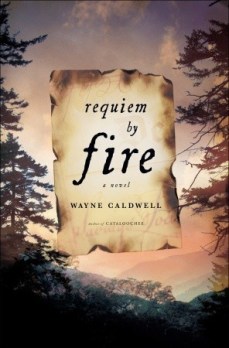
The Monday Book: REQUIEM BY FIRE, a novel by Wayne Caldwell

requiemSorry so many Mondays have slipped past. I have started many books that didn’t make me want to finish them, this past month. And then came REQUIEM, a story so enticing it makes me go to bed early just so I can read.

The book is set in the late 1920s and early 1930s, and focuses on what the establishment of the Great Smoky Mountains National Park did to the people it bumped.

I know these people – Jim the local boy who wants to return home and work, the successful man; his wife Nell who wants to follow in the footsteps of her overbearing mother and get the hell outta there to a place with electricity and running water; Silas the contrarian who will be carried off the mountain feet-first, one way or another; the lawyer who turns on his own people and gets over his regret. They sound like stereotypes, but these folk walk, eat, and most definitely talk like real North Carolinians.

The tension between the people who live on (and off of) the land, and the government officials, some clueless, some very clued up indeed, flows under the rest of the action. Actually, this book is less action than scene by scene contacts between people, dialogue sent against lightly descriptive background. I am a sucker for well-drawn characters having pithy, realistic conversations, and this book is that in spades. Not a fan of a lot of description myself, I nevertheless was hooked by the opening scene of the novel, depicting an act of benevolent arson.

The ending will not be given away in a spoiler because I haven’t finished it yet. This is a book to savor. I’m so glad to have found something that restores my faith in Appalachian fiction!

The Monday Book-turned-Movie: CLOUD ATLAS

Cloud-Atlas-Actors-Different-Characters

I know, I know, you’re very disappointed in me. But I’m on a crochet deadline, and was  looking for Netflix background–less Netflix and chill than Netflix and hook, but there you go.

So I watched Cloud Atlas because the book by David Mitchell had intrigued me but we sold it before I could rad it. And three hours of movie lets one get a powerful lot of yarn moved into correct position.

The thing about this movie is it was able to add something the book wasn’t: jokes about who was playing what part.

For those unfamiliar, Cloud Atlas is pretty much based on the idea that no matter what century it is, people are behaving pretty much the same. There are good guys, bad guys, hustlers and altruists, and it all moves around in a big circle.

The funniest part is, the hunk hero from 2143 or so is the matron of an evil nursing home from 2012. That part cracked me up. Although the fact that “soylent green is people” was a funny line in 2012 and a real thing about food in 2143 was a bit sobering.

Cloud Atlas runs from the 1800s, when on ships running from Jamaica a bad guy is trying to poison a nice guy who saves another nice guy from getting beaten to death, through the 1970s when corruption in the oil industry is getting nice people killed, past 2012 when it’s the publishing industry and nursing homes that get the scrutiny, into ethical futurist questions in 2100 and 2300 (after the fall a few winters, if that tells you anything) when Earth is back to barbarism. If you don’t take it too seriously, it’s a good film. If you start to ask questions about how people know certain things or can gain access to certain places, forget it. This is a shallow, bright ride.

But it is a ride with some breadth, as the 2100s are shoot-em-up thriller, the 1970s are detective novel, 2012 centers around money, and 2300s is eat or be eaten with a few surprises thrown in. It was as bright and breezy as the afghan I was crocheting while watching, and less knotty if one didn’t ask too many questions.

For escapism or background noise, Cloud Atlas works well. For serious thought fodder, one doesn’t need two hours and 51 minutes of star-studded cast to know that everyone is pretty much after something, for good or ill, and that we recycle stock characters in the parade of our life. History repeats itself because we don’t learn the lesson the first time. Just ask Charlottesville.