
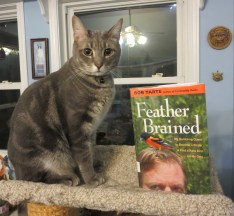
 Feather Brained: My Bumbling Quest to Become a Birder & Find a Rare Bird on My Own by Bob Tarte
Let me start out by saying I am a not a birder. I can identify cardinals, robins, blue jays, and woodpeckers—providing the latter are pecking on wood when I see them. That’s about it. I thought birders must be born, not made.
Then I read Bob Tarte’s book Feather Brained. Bob was not a natural birder. At the tender age of nine in an effort to be cool, he set out for the park armed with a second-hand book on birds and a set of opera glasses. Let’s just say that first foray was less than successful.
A mere twenty five years later, Bob was ready to strike out again. This time the impetus was due to an even rarer find: a red haired lady named Linda with a love of life in general and nature in particular. He gets identification books, listens to recordings of bird song, and joins online birding groups where alerts are posted so members can rush to an area and maybe, just maybe, spot a bird for their life list. It becomes Bob’s mission in life to spot such a bird so he can alert the group and be the hero for once.
The phrase “easier said than done” springs to mind at this juncture.
As with his earlier books (Enslaved by Ducks; Fowl Weather; Kitty Cornered), Bob writes with a self-deprecating humor. Comparisons to Charlie Brown and his little red haired girl will not go amiss, although Bob also has to deal with Churchill’s black dog of depression. His eye for detail and description is as keen as ever, even when prowling around a sewage pond for rare birds. He’s accompanied on many of his expeditions by Bill Holm who, as Bob explains, “didn’t particularly like birds, but he liked them more than he liked people.” Bob’s strength as a birder is to identify birds by their songs, so he depends on Bill to spot the birds, point out his errors, and make unmerciful fun of him for being so wrong. Even though some of the episodes border on slapstick in Bob’s recounting—I laughed out loud as he and Linda risk life and limb to check out an osprey’s nest built on a train trestle—the book was a wonderful look at how birders can indeed be made, not born. I found it reassuring as Bob misidentified wrens, grew frustrated at distinguishing calls, and sulked at birds that wouldn’t show up where they were supposed to be.
But above all else, Feather Brained is a romance. Oh, sure, Bob learns to love birds and birding, but it is his love for Linda that shines through the pages. They would seem to be polar opposites: Linda is the free spirit who lived happily in a small trailer in the woods while Bob enjoys creature comforts like electricity and running water. Where Linda sees rainbows, Bob sees dark clouds with tornado potential. Love conquers all, however, and throughout the book Bob’s devotion never waivers, not through feeding mealworms to orphaned starlings, chipping away ice for the ducks, or being pelted with soggy monkey chow by a cantankerous parrot. It must be true love.
And, hey—maybe I’ll take another look at that bird book I have in the basement.
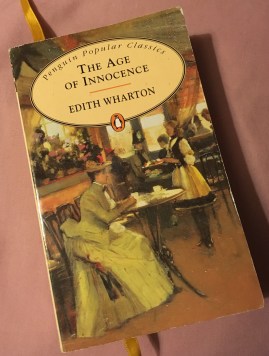 When I was a teenager, Penguin produced a range of classics for a pound a book. I’m not sure how mid-90s money translates across the Atlantic, but for this reader who’d only very recently discovered the joy of bookshops it was a revelation.
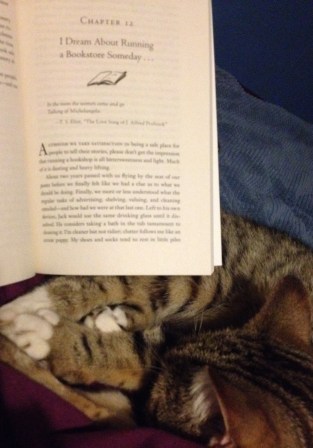 Erica Jones is a bookshop blogger, owned by a rescue cat called Dolly.
 Wendy Welch: Books, Yarn, Cats, Opioids