
The Monday Book: THE GUERNSEY LITERARY AND POTATO PEEL PIE SOCIETY

by Mary Ann Shaffer and Annie Barrows

book gurnseyAs a rule I don’t like books that are written in letter form, but this is one of my favorite novels ever. Perhaps because it was written by two authors, they were able to give the various writers of the letters (and diary bits and telegrams, etc.) such varying voices and characters that they form a wonderful comprehensive picture of a community under stress–nice guys, mean people, weirdos, and all.

The book is about the German Occupation of Guernsey, one of the Channel Islands. It’s not something that has a lot of literature to it, perhaps because “A Model Occupation” (as a non-fiction book about the same subject is titled) can be embarrassing in politics. But the writing of this aunt-niece combo is just lovely. Poignant, gentle, understated elegance meets raucous humor.

The characters are believable, the situations drawn from real events. Terrible things lie next to sweetness and fun–like the letter from Micah Daniels to Juliet Ashton, dated 15 May 1946, in which he recounts “for your book” (Miss Ashton is working on a post-war history) when the Vega Red Cross ship brought the starving islanders food, and the starving German soldiers actually gave it to them–then one soldier stole an islanders’ cat and ate it.

That kind of thing.

The stories are intense, and so very human. In fact, although I suspect the late Ms. Shaffer would roll in her grave to hear this, Potato Peel reminds me of World War Z (the oral history of the Zombie Wars). They have the same straightforward storytelling, the same delivery technique (recordings versus letters, though) and the same darkness-and-light amalgamation. They’re too normal not to be believed, even as they describe one of the most horrific times in history, and one of the most horrific (and unbelievable) apocalyptic scenarios. Maybe that’s why World War Z is more popular – it didn’t happen. Many things like this in Potato Peel did. You can read about the historic research Shaffer did, and how she got interested in the Channel Islands in the first place, with a simple Google search, if you want to.

But I’d recommend reading the book first. It’s a great read, and very thought-provoking.
Never Judge a Book by its Black Sack Covering

books It continues to be a delight to have our lives revolve around the bookstore, to meet folks almost every day who have read Wendy’s book and made a trip to see us, and to be surrounded by ‘bookstore friends’ at the regular events we put on.

But in the middle of all that fun, we deal with the more mundane–and often tedious–jobs such as pricing and shelving the donations and books that show up—usually at the busiest times of the day or week. These unforeseen arrivals often come by the truckload, and that can be a real challenge., since we no longer have hidden spaces to store books until we can find time to sort them. In some cases, we wind up checking their current value on the Internet as well as “stick-n-stash” (as we have ignobly nicknamed pricing and shelving).

A few days ago Wendy was sitting back heaving a sigh of relief, having just dealt with a slew of these incomers; they’d arrived in dribs and drabs throughout the day, and she was proud of having cleared them in a timely manner despite having a record number of customers in the shop.

And then the door opened.

In came our good friend Cyndi Newlon (you can see her in the video tour of the bookstore, playing the corpse in our mystery room). http://www.youtube.com/watch?v=03cmGdapxPQ

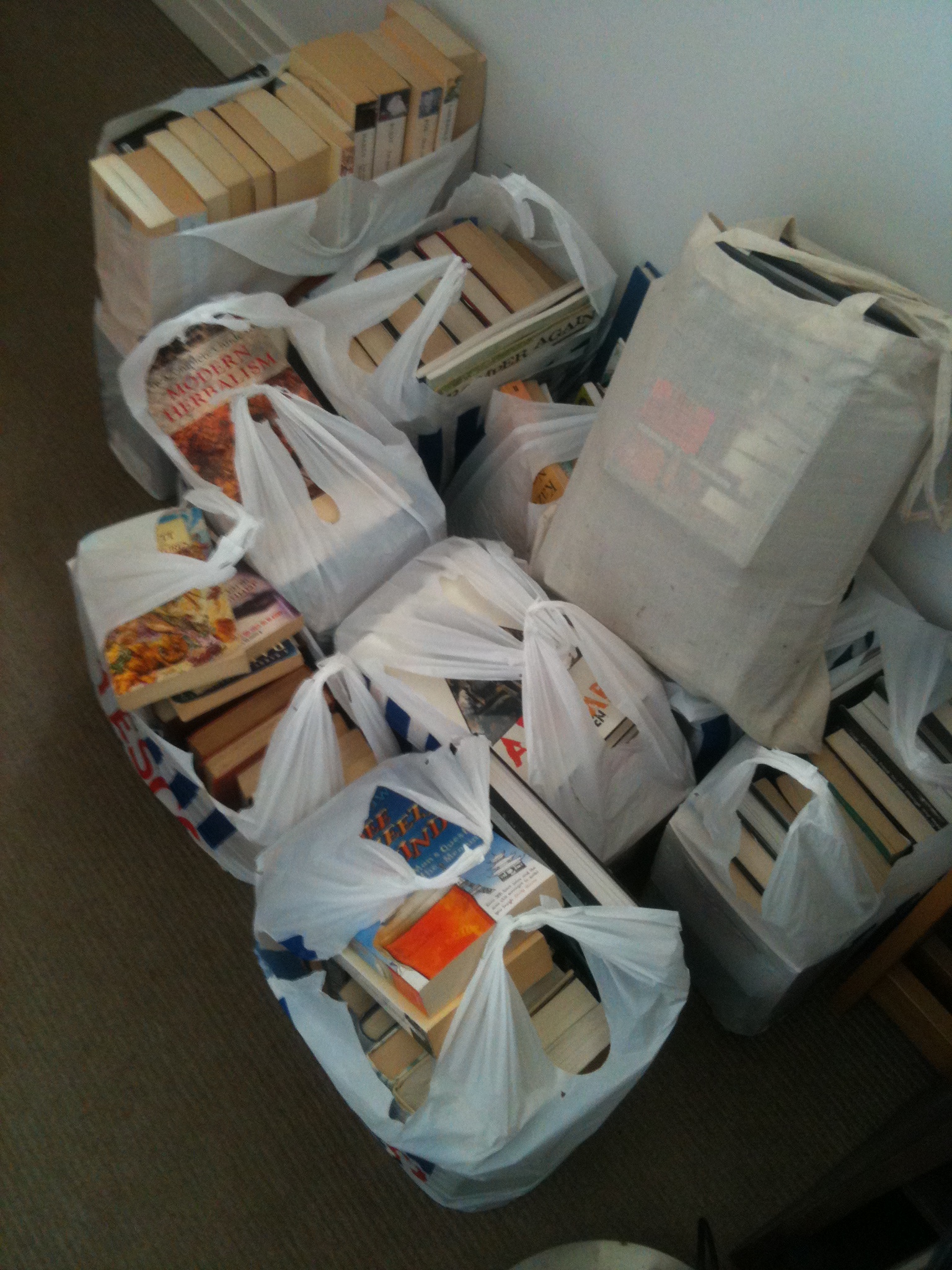
Cyndi runs a writing center at the nearby college, and she’d asked if we wanted “some old library books.” Apparently, today was the day, and “some books” turned out to be ten large tightly knotted black sacks. Each one was seriously heavy, I discovered, as I helped get them out the back of her SUV and up onto the dry half of the porch.

I had been in the process of getting to grips with our brand new power washer, cleaning the soot of our front porch and outside chairs and tables after the recent big fire across the street. The arrival of Cyndi was a mixed blessing – respite from wrestling with the washer, but ….

We knew that the sacks couldn’t be left lying outside, so there was nothing for it but to dive in and start checking. Old library books are a mixed bag, often useless, but sometimes wonderful. We quickly turned up two or three hard-to-find William Faulkners, as well as quite a few rather attractive very old poetry and short story collections.

Our hearts beat faster. We warmed to the task. It’s not easy to explain to “normal” people, but bibliophiles will understand the excitement of digging through opaque sacks of old books, exclaiming over long-forgotten friends, discovering new titles.

And that’s just thinking of them as books. When you think of them as objects to be sold, well, usually with old worn ex-library books you’re lucky to find maybe one or two in every fifty that would worth hanging on to, but we were amazed with this collection. As we trawled through, we found many first editions, along with rare titles containing beautiful illustrations.

So we are grateful to Cyndi and Don for thinking of us and, once again, we learned to be grateful for what on first blush looks like a lot more work at a busy time. And we learned that you never know what good things might be hiding in a bulging black sack.