A Beautiful Day, and a Long One

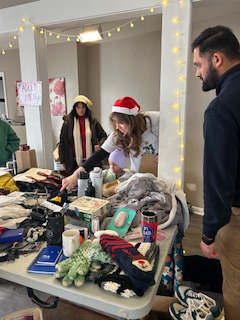
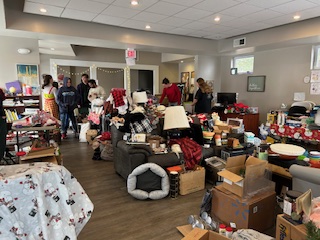
Saturday past was our Christmas Market. That’s when the medical students who have spent the year working with a rent-controlled apartment complex (making meals, playing sports, running crafts and edutainments) bring all their donations and spread them out on tables. Kids come with a list of people they want to find presents for, and shop with help from a med student. Everything is free.

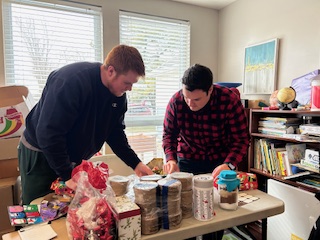
Then they get the presents gift wrapped (we always get the future surgeons to do this; they make the best wrappers) and go home happy. They got to choose things and a bunch of adults paid attention to them. The med students go home happy from making the kids happy. The parents are ecstatic because we’ve solved a problem looming large in their mind.
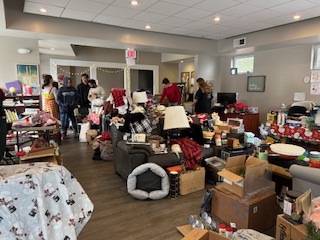
Some people told us early on that we were being terrible, taking yard sale leftovers and presenting them as giftables.

Those people didn’t know shit. One of the kids, walking around looking at all the donations, said “This is the most generous place I’ve ever been to. This is awesome.”

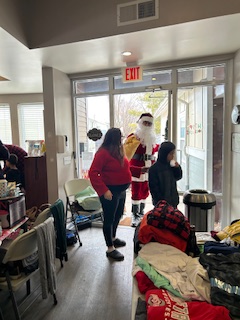
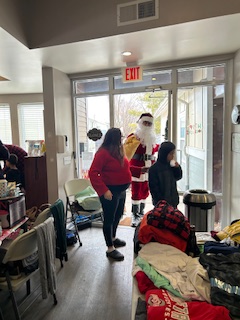
The med students arrived at 9 am and we spread out the stuff. The market opened at 2. One of the med students discovered there was a Santa suit, and he went off with it when we broke for lunch. Since he was about 21, skinny like a beanpole, and Hindu, I had my doubts, but he came back with a squishmallow strapped to his stomach, the beard on askew, and a large tub of candy canes he picked up at Walmart “to make it official.”

His “Ho Ho Ho” came out “hu hu hu” and the kids LOVED him. We ran out of tape and started packing presents into donated purses and backpacks, then slapping bows on these. “Double presents” we told the kids, with just a hint of mania behind our Christmas cheer.
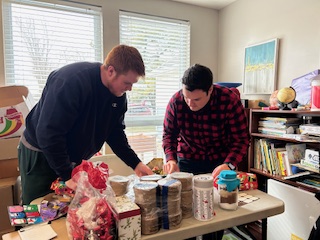
It was a glorious day. The parents thanked us, the kids left sticky candy canes all over the place, and the med students removed several sharp implements from the donations as we spread them out. We went home covered in tape, tinsel, and joy.

This is Christmas.
Jason: A Retrospective

Taking a break from Occupation

Jason was my classmate in first grade. I had a crush on him, and he was always friendly to me. Had we been sixteen instead of six, things might have been different.

One day after recess Jason was upset. I could see it, but not why, and he kept shooing me away when I tried to smother him with kindness.

Circle time came, and Mrs. Fannon asked us to share our feelings, calling randomly on kids. Looking back, I am not sure quite why this was good technique, but we thought the sun rose and set on her red-dyed hair.

Like a lot of us, Mrs. Fannon had transplanted into our Detroit classroom from Kentucky. My parents were Appalachians. Jason’s parents were Georgians. While we had a smattering of Iranian revolution refugees, a fair few Vietnamese kids, and some Mexican children whose dad worked construction and who we knew (even at our young ages) would not be with us for the whole year, most of my school was Appalachians who came north to find work. We ate biscuits for breakfast, swore using tarnation and hellfire, and said “Yes ma’am” instinctively to almost any query.

Mrs. Fannon called on Jason and he said “I ain’t doin’ so hot.”

“Aren’t,” said Mrs. Fannon. “Why is that Jason?”

Jason said he had been running a race with one of the boys from an older class, and when he won, the older boy called him a derogatory name for people with black skin like Jason’s.

Mrs. Fannon looked troubled. Then she asked if Jason knew the boy’s name.

“Yes ma’am.”

Did Jason know what classroom he was in?

“Yes ma’am.”

Would Jason like to go and confront the boy, tell the teacher what he did, ask for an apology?

Jason hesitated. He was a smart kid, and I could see him reckoning with what I was considering in my own head: Alone?! Go ask to see this kid in the hallway, or in front of his classmates, and call him out? There were consequences for kids who did that. Especially ones who were smaller than the one being so shamed.

Shame, though. That was the operative word here, wasn’t it? This kid had tried to shame Jason. Jason was cool. Jason was kind. Jason was smart. And apparently Jason was faster, which is why the older boy got mad.

Jason swallowed, and said, “Yes ma’am.”

While he was gone, Mrs. Fannon said she hoped none of us would ever use “a word like that.” One of the Vietnamese kids raised her hand and asked if that would also include… and out of her innocent mouth popped a term very unpleasant to Asian people.

Mrs. Fannon gulped. “Yes, it would, and we don’t need to list them all.” She added this as hands began to pop up around the circle. “We never say or do anything that makes another person feel less than us. There’s a song about this, and I bet you all know it.”

She launched into a scratchy version of Jesus Loves the Little Children, pitched a bit low for six-year-olds, but we wallowed along behind her. Even the Muslim kids.

Jason didn’t come back until circle time was over. He resisted my attempts to extract information on whether the mission had successfully healed the hole ripped into his heart. He withdrew from playing with the group of white kids who often ruled the jungle gym, where he had encouraged me to climb higher each time, overcoming my terror of heights.

That was April. We left school in May, and next year Jason wasn’t in my classroom.

As an adult, I still contemplate what Mrs. Fannon did then: 1) there was no one to watch her class 2) she was a transplanted rural Kentucky woman in 1970s America  3) she sent a child into the void. What shall we make of these circumstances?

I don’t know. I don’t know what happened to Jason, either, but I think of him sometimes, randomly, and that day when we dragged our voices behind Mrs. Fannon, singing “Red and Yellow Black and White” in a class full of first graders in a classroom with a chart of color names on the bulletin board. But not their powers.