
 Give us an inch, and we’ll build a bookshelf. Those of you who have read the book or visited our shop can picture the place: is there a space left where we could put up another? (Regular readers may recall, from our November visit to Philly, the outrage Jack expressed at finding Walk a Crooked Mile Bookshop had indeed used their bathtub.)
Yet on Thanksgiving Day, we found three. The bookshop was closed, Jack and I invited to a 4 pm dinner to which we planned to take Cookie Glass’s frozen-in-waiting cookies, so we didn’t have to log kitchen time. With the day clear before us, we swung into frenzied action.
Jack knocked together a standard “sleepbuilt” for under our last untouched window; created a special construction to slip over the counter in the half of our kitchen that is crafts and cookbooks; and built a skinny, tall bookcase—which, due to the influence of my Seattle coffee-fiend friend Cami, I can’t help thinking of as “the latte”—for just outside the bathroom door.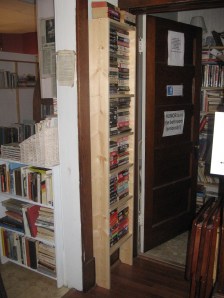
Surveying the latte that is two pocket paperbacks wide and six shelves high, Jack said, “That isn’t a bookshelf. That’s spatial sarcasm.”
But it worked. We now have a “BARGAIN BOOKS” section where paperbacks can go to die. $1 each, or 10 for $5, not returnable. Enjoy, folks.
And perhaps, just perhaps, this time when we stand back-to-back in the center of our store, surveying 360-degrees while saying, “OK, we’ve found the last space where we can put a bookshelf”—well, maybe this time it’s true.
Although I do keep eying the downstairs bathtub….
 Wendy Welch: Books, Yarn, Cats, Opioids