
Jack guest blogs today on the perils of Scotsmen decorating under the direction of their American wives.
I come from a country that doesn’t decorate itself for Christmas to quite the extent that Big Stone Gap (and the rest of America) goes in for. External decorations are virtually non-existent in Scotland, and internals don’t get put up until the week beforehand.
Thus I have always harumphed in a Scrooge-like way when instructed by Wendy to haul “the Christmas stuff” down from the attic. Our compromise is to wait until Dec. 1—our neighbors have their bright flashing festoons in place Thanskgiving Night—before installing Rudolphus in the front yard.
Rudolphus we purchased a few years ago, in a flush of enthusiasm on Wendy’s part not entirely shared by me, but I like it when she’s happy, so home he came–a white deer with head bowed “as if reading a book” said Wendy in the shop, clapping her hands with glee.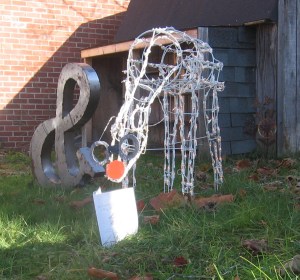
{sigh}
Our compromise then was to not have him lit up – more of a wire sculpture alongside our growing collection of other yard art, such as the giant ampersand and the post-modern ironic toilet bowl of petunias. I made Rudolphus a pair of spectacles and a red nose, and posed him each year reading an appropriate (and annually different) book.
This year I finally succumbed, though, and strung a power cord though the garage, out the window and across to ye olde Rudy. Switching on the power I discovered that, while his torso shown brilliantly, his neck and head refused to emit even a glimmer of light—headless, as if he’d pissed off a Tudor King.
A quick examination revealed a severed wire, like no other I’d ever seen. Some kind of impregnated central core instead of the expected copper refused all my attempts to reconnect it.
So there Rudolphus sits in half-hearted celebratory condition, determined (it would seem) to continue the Welch-Beck decorating compromise: his heart in the US and his head in Scotland.
And yes, he is reading Wendy’s book.
 Wendy Welch: Books, Yarn, Cats, Opioids