Of Thunder Boxes and the White Man’s Burden

Jack guest posts the Monday Book Review

It it was in the 1970s, or maybe even earlier, that I remember watching a TV adaptation of ‘Sword of Honor’ by Evelyn Waugh. It starred Edward Woodward and my sides were sore laughing at it. In fact I was motivated to buy the book, which is how I fell completely for Waugh’s writing.

His style is a combination of high humor and biting satire combined with truly engaging stories that won’t let you stop reading until the last word and full stop.

Since then I have read his other great works – ‘Scoop’ and ‘Black Mischief’ and found them equally hilarious and thought provoking. Of course his world-view is of his time and within the setting of the books – mostly the 1930s and 40s and the British Empire. He pokes fun in every direction and no one escapes his eagle eye. Sadly he is sometimes, nowadays, regarded as a bit ‘non P-C’ which is very unfortunate!

One reviewer of ‘Black Mischief’ described it as “Joseph Conrad meets Monty Python” and that’s a wonderfully apt description. The reviewer goes on – “’Black Mischief’ is not a safe book; it delves into racial and political divides as wide now as then and lets you know its author isn’t aboard for any of that 21st-century sensitivity rot. Despite or perhaps because of this it is a good book, perhaps a great book, and worthy of your time.”

One of the things I love about Waugh is that he lampoons everyone equally, including himself through his ‘white man’ leading characters. The absurdity of human nature and particularly of white colonials is laid bare here.

I haven’t read all of Waugh’s books and that means I still have further delights ahead of me.

I hope I have persuaded you to give him a try as well!

Think Pretty Maids how you Court Young Men

Jack and I swung past Colonial Williamsburg on our way home from DC, as neither of us had visited before. And guess what… they were having a Southern Textiles display!

Poor Jack – it was his birthday and all, but he passed a pleasant hour in the mental hospital exhibit while I went, stitch by stitch, through the museum with the curator, who was delighted to have someone who liked needlework with which to discuss its intricacies.

But there was one piece Jack and I could both enjoy before he left – this quilt from the early 1800s, done by a lady with eleven children. Three of her quilts, all gifts to her kids when they got married, hung in the exhibit. After viewing this one, all I can say is, she must not have liked her daughter’s chosen husband.

pretty maids courtingThat girl definitely looks dubious, and if Jack had courted me hunched over and grabby like that, things would have turned out different.

Come all you fair and tender ladies

Take warning how you court young men…….

It’s a ballad Jack and I sing often when teaching Transatlantic balladry, as versions are found in the British Isles and the Appalachian Mountains. And it definitely applies to this poor child. The exhibit never told how those marriages ended, but I was reminded of the short story A Jury of her Peers. This is the piece in the literature textbook that every school child in America remembers as “that quilt story about the murder.”

Two women come to the house of a third who may or may not have murdered her husband, and as their husbands tramp about looking for clues, they discover via her quilting that she did it, because her husband killed her beloved pet. And they hide the fact from their husbands, who have been condescending to them about their wanting to take the piece work to the jailed woman, so she’d have something to do. It’s like that other great short story Lamb to the Slaughter, where the cops eat the evidence (woman kills her adulterous husband with a frozen leg of lamb, then cooks it up for the investigators) because they can’t expect a woman to 1) kill and 2) be smart enough to cover it up.

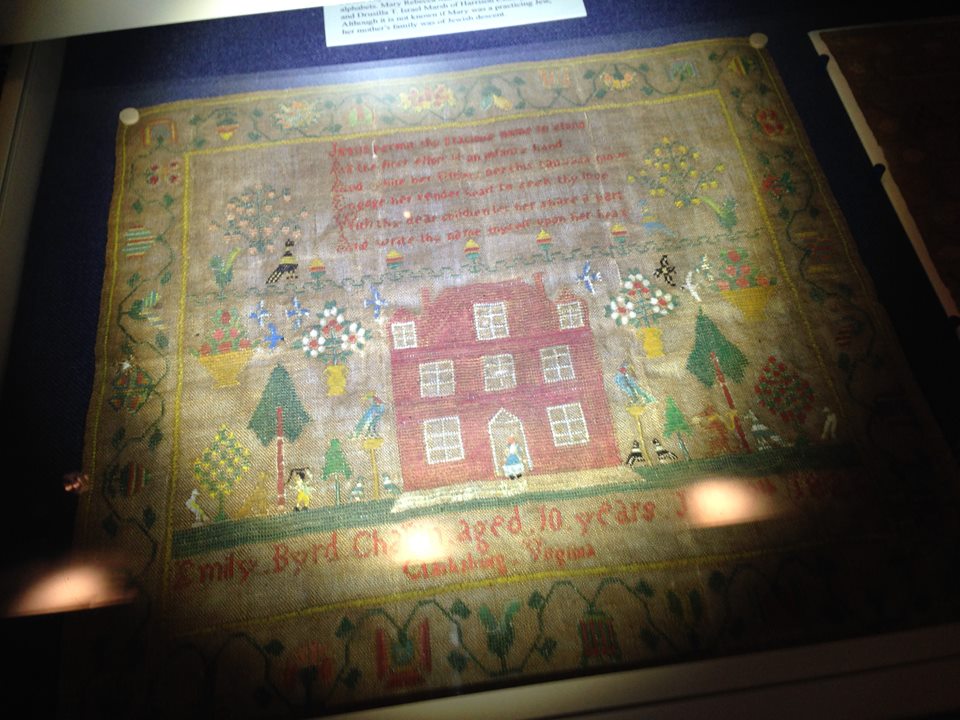
I love textiles. And one of the best parts of the visit was talking to the guide about the division between samplers that had religious poems–of which there were many–versus nature scenes in them. I speculated that the girls who did animals may have been of a slightly rebellious nature, tomboys, and she shot me a shrewd look.

sampler“I actually speculate that it was the other way ’round and the roughest girls were set pieces with the strictest verses,” she said. “Look at this one.” She pointed out a sampler about devotion and piety, very badly stitched. “This kid was pretty much sabotaging her own work, more power to her.”

Attagirl, girls. I love the power of women in subtle things – since the 1600s, when life hands us needles, we jab them into that which annoy us. :]